Some may believe that Apple has loosened its grip on the App Store following its recent legal battles, but the tech giant proves once again that it never sleeps. The popular calorie-tracking app, Cal AI, recently found itself outside the walls of the Apple App Store, and the reason wasn’t just an attempt to bypass Apple’s commission, but the use of deceptive and misleading tactics against users. Let’s dive into the details of this drama and how Apple proved that it is still monitoring every detail to protect us.

The Story Behind the Ban: Not Just an External Payment System
The story began when Cal AI, an app developed by two high school students that generated $50 million in annual revenue before being acquired by MyFitnessPal last March, suddenly disappeared from the App Store last week. Initially, many assumed Apple had removed the app simply for using an external web-based payment system instead of its own In-App Purchase system.
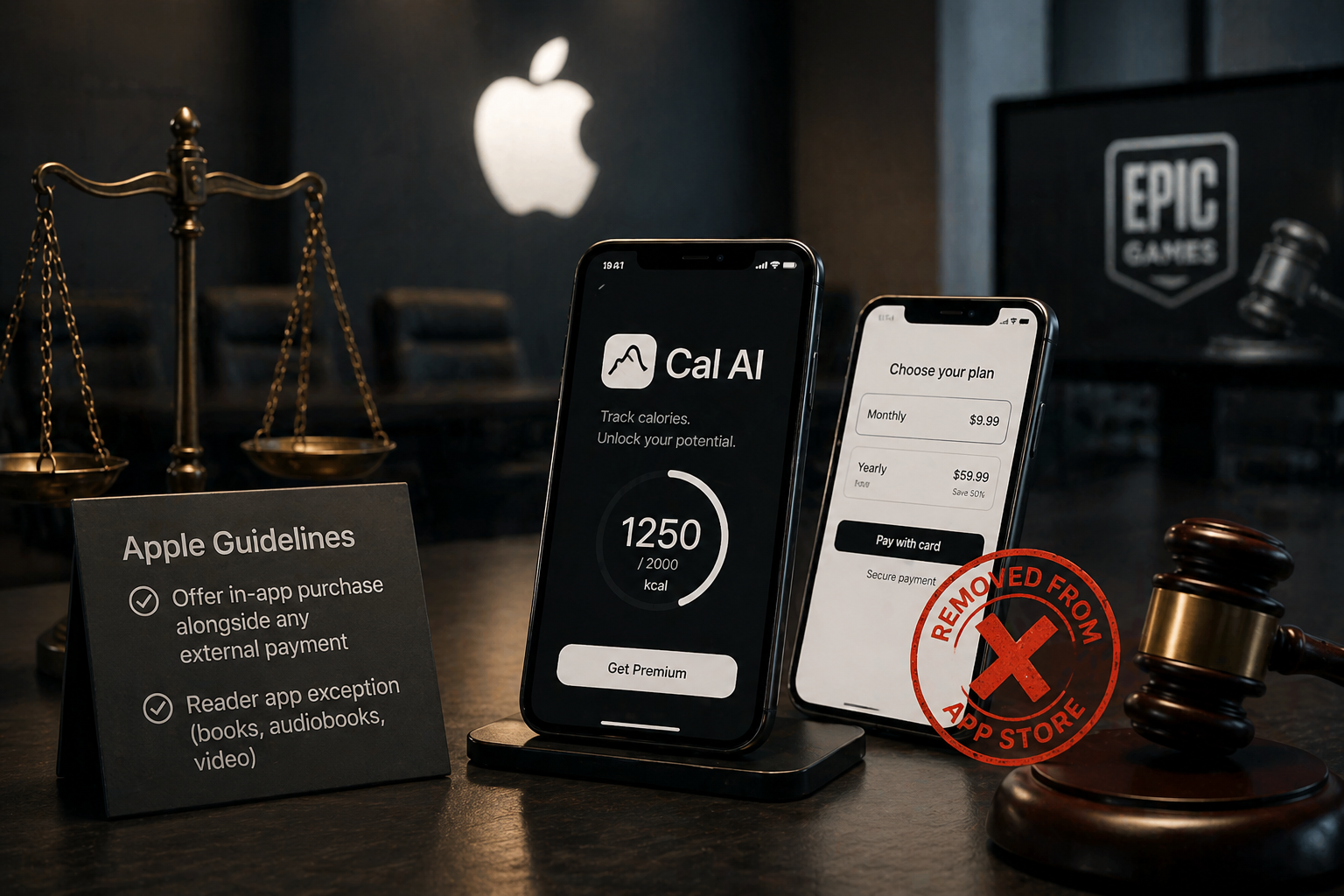
However, as we know, Apple now allows developers in the United States to provide links to external payment methods thanks to the settlement in the famous Epic Games case. Nevertheless, Apple’s golden rule states that its own payment option must be offered alongside any external option, unless the app is classified as a “Reader” app (such as books, audio, and video apps), which does not apply to Cal AI at all.
Wholesale Violations: How the App Tried to Deceive Users
When TechCrunch contacted Apple, the response was firm, revealing that the removal was not just for a payment link, but due to multiple violations of App Store rules. The first and most prominent violation was bypassing Apple’s purchase system entirely; the app integrated a third-party payment interface (Stripe) to unlock paid features and completely hid Apple’s payment option, which is a clear violation of Guideline 3.1.1.
But what is truly disturbing are the “misleading” billing practices that violated Guideline 3.1.2c. Imagine signing up and seeing the weekly price displayed in bold and attractive text, while the actual total amount to be charged to your credit card is nearly hidden! Add to that a “Free Trial” button specifically designed to obscure the details of the automatic subscription renewal. In short, the app set a well-crafted marketing trap to ensnare users.
On top of that, the app used “manipulative tactics” that violate developer conduct rules. If you dared to decline the first subscription offer, the app would immediately hit you with a different subscription offer in a desperate attempt to drain your money. These crooked practices naturally led to a flood of negative reviews from users who felt deceived and described the app as a “scam.” Here, Apple had to intervene like a strict traffic cop to protect its users.
The Return and the Lesson Learned from the Apple
After this strong “ear-pulling,” the developers of Cal AI rushed to comply with the rules of the game, correct these violations, and remove the deceptive tactics. Indeed, with a forgiving heart (as long as the rules are followed), Apple allowed the app to return to the store, where it currently ranks fourth in the Health & Fitness category. Despite attempts to contact the developers for comment, they chose to remain completely silent.

Perhaps the app was trying to “test the waters” and see how vigilant Apple was after the recent changes to store policies, but Apple’s response served as a resounding warning to everyone: Apple is still the faithful guardian of its store, and it is prepared to sacrifice its share of revenue from a viral app making millions of dollars if the price is compromising the safety and transparency of the experience we trust as Apple device enthusiasts.
Source:


Leave a Reply