In a quick and sudden retreat that proves privacy remains a red line for users, Meta has decided to remove a controversial feature in its new AI image generation model, just less than a week after its launch. It seems the torrent of sharp criticism and user outrage was enough to teach the company a quick lesson in respecting personal spaces and private data.

The Story Behind the “Sneaky” Feature
The story began when Meta announced its new Muse Image generation model, which allows users to create high-quality visuals and share them directly in stories or posts. So far, it seems normal and traditional compared to what competing companies like OpenAI or Google offer. However, as is often the case with Meta, there was a hidden and highly concerning clause that was quietly slipped in.

The company decided, without prior warning or explicit permission, to use the public photos of all Instagram users as fuel to power its AI image generation tool. This meant that any stranger could type your account name (via an @-mention) into the Meta AI app, and the AI would pull your public personal photos and use your features to create entirely new images, without you even receiving a notification that your photos were being used in others’ digital fantasies!
The Buried Opt-out Option and Union Pressure
Of course, Meta did provide an opt-out option, but as usual, it was buried deep within the app’s convoluted settings, accessible only to those who searched for it with great difficulty and prior knowledge. The company did not send any in-app alerts to inform users that their photos had become fair game for Meta’s AI, opting instead to mention it in a technical blog post that only a few specialists read.
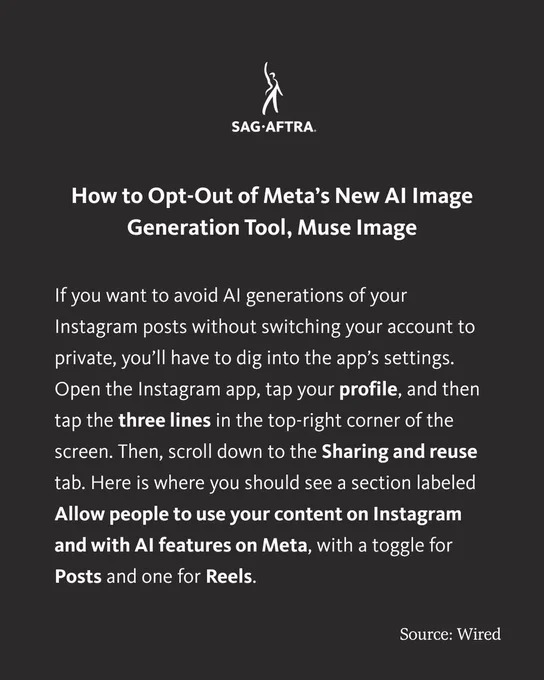
This blatant disregard for privacy sparked a massive wave of outrage that was not limited to ordinary users. Major entities intervened, such as the Screen Actors Guild (SAG-AFTRA), which immediately demanded its members opt out to protect their rights and images from digital exploitation. Public safety organizations, such as the National Center on Sexual Exploitation, also called on Meta in sharp terms to immediately retract this move, warning of the ease with which this tool could be misused for extortion and the creation of explicit deepfake images.
The Official Retreat and Deepfake Concerns
Faced with this immense pressure, Meta raised the white flag just three days after announcing the feature. The company published an official update in which it indirectly apologized, stating: “We aimed to provide a useful creative tool and give users control, but we listened to feedback confirming that this feature missed the mark, and therefore it is no longer available.”
What happened brings to mind the chaos caused by Elon Musk’s Grok tool on the X platform earlier, when it allowed users to tag accounts to generate unethical and offensive deepfake images without the owners’ consent. Although Meta claims there are guardrails in its system, preventing generative AI from crossing ethical boundaries remains a losing battle if the door is not closed from the start and user privacy is not truly respected.
Source:


Leave a Reply