It seems Apple finally decided to spare repair engineers and users alike, as if it woke up from a long glue‑induced slumber that lasted for years. Can you believe there’s a new MacBook that doesn’t require a whole bottle of solvents to remove the battery? Yes, we’re talking about the new MacBook Neo, whose initial teardown revealed surprises we weren’t accustomed to from Apple. Starting at $599, this device appears not only budget‑friendly but also a true friend of the screwdriver, featuring an internal design that completely avoids the complex adhesives that characterized the company’s other laptops.
Small Logic Board with a Powerful Heart

The teardown published by the repair shop Tech Re‑Nu began by removing just four screws to open the bottom cover, providing immediate relief. What the technician found inside was impressive: a surprisingly small logic board, noticeably smaller even than those in the MacBook Air. This tiny board houses the powerful A18 Pro chip, proving that size isn’t everything when it comes to high performance.
The removal of the logic board was extremely smooth, as it could be freed easily after disconnecting a few clearly labeled flex cables for the display, trackpad, microphones, and other components. This organized layout is not just technical elegance; it truly simplifies maintenance, which previously demanded a lot of patience and caution.
Goodbye to Glue Nightmares: Battery Under Control
The biggest surprise that could bring tears of joy to any repair technician is Apple’s approach to the battery in the MacBook Neo. Instead of strong adhesive strips or glue that demand massive effort to remove, the battery is secured to the chassis with just 18 screws. Once those screws are removed, the battery slides out effortlessly, as if announcing the end of the era of complexity.
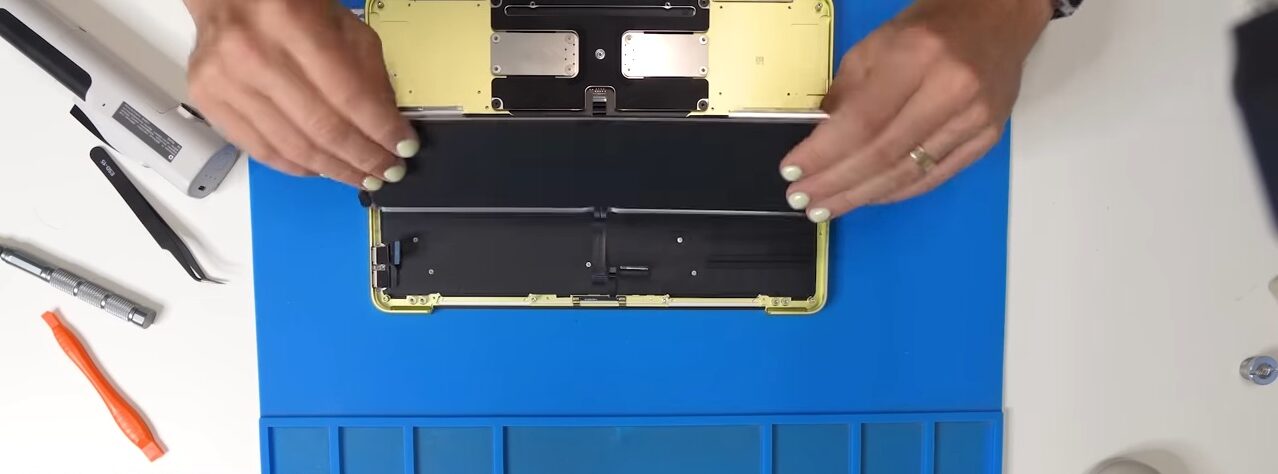
The story doesn’t stop at the battery; the speakers are also mounted with four screws and can be lifted effortlessly without any contact with annoying adhesives. This design approach reflects Apple’s desire to reduce manufacturing and repair costs for a device targeting a broad economic segment.
Exceptional Modularity and Speed in Disassembly
The modularity of components extends to other laptop parts; the audio jack, trackpad, and USB‑C ports are all independent pieces that can be replaced individually if they fail, without needing to replace the entire logic board. The technician managed to fully disassemble the device in under ten minutes, a record time that reflects the simplicity and elegance of the internal design.
This internal simplicity aligns with Apple’s efforts to reduce waste, as the company employed a new aluminum casting process to build the outer chassis with less material and minimal scrap. It appears that the focus on efficiency has shifted from the exterior to the finest internal details, making the MacBook Neo a benchmark for repairability.
The Future of Macs on the Repair Path
The MacBook Neo’s design is not merely a cost‑saving measure; it’s a clear message from Apple that it can deliver powerful, elegant devices that are also easy to maintain. The disappearance of hidden hinge covers and unnecessary complexities makes us wonder: will we see this approach in future MacBook Pro releases?
The device is now available for order at $599, a price that seems very reasonable given the power delivered by the A18 Pro chip and the ease of handling its internal components. Apple didn’t just build a laptop; it crafted an engineering masterpiece that respects engineers’ time and users’ wallets.
Source:


Leave a Reply