Artificial intelligence is not just changing the world; it is inventing an entirely new language to describe how it does so. If you spend just five minutes reading about this field, you will encounter a flood of acronyms like LLMs, RAG, and RLHF, along with other terms that might make even the most tech-savvy person—like you, my friend—feel a bit confused. We at Phonegram, as enthusiasts for all things advanced, have decided to put an end to this confusion and provide you with a simplified guide that explains these terms clearly, so you can be fully aware of what is happening behind the scenes of this technological revolution.

Large Language Models (LLM)

A term we hear daily is Large Language Models (LLM), which is the engine powering tools like ChatGPT, Claude, and Gemini. These models are deep neural networks containing billions of digital parameters (weights) that learn the relationships between words and phrases. They are created by processing patterns found in billions of books and articles, allowing them to generate text that closely resembles what humans write.
Deep Learning

These models rely on Deep Learning, a branch of machine learning inspired by the structure of neurons in the human brain. The power of deep learning lies in the ability of algorithms to identify important characteristics in data on their own, without the need for human intervention to define them. Naturally, this requires massive computing power (Compute) based on advanced Graphics Processing Units (GPUs), which explains the frantic race among companies to own as much of this hardware as possible.
Artificial General Intelligence (AGI)

We start with the most controversial term: Artificial General Intelligence, or AGI. This term refers to a type of artificial intelligence that surpasses humans in most cognitive tasks. Some describe it as a fully autonomous system that can perform human work with ease, while others see it as a super-intelligent digital colleague. The truth is that experts themselves are still debating its exact definition, but it represents the ultimate goal sought by companies like OpenAI and Google.
AI Agents

As for an AI Agent, it is a more practical step; it is not just a chatbot you respond to, but a tool that uses AI technologies to execute a series of tasks on your behalf. Imagine a digital assistant on your iPhone that can book flights, organize your expenses, or even write and debug code independently. An AI agent goes beyond just talking to acting, as it connects multiple systems to accomplish complex, multi-step tasks.

In a related context, we find Coding Agents. These are the specialized version of AI agents in the field of software development. Instead of suggesting code for you to copy, a coding agent can write, test, and debug code completely independently. Imagine hiring a very fast intern who never sleeps and never loses focus, capable of handling entire databases and fixing vulnerabilities with minimal human intervention.
Chain of Thought

Have you ever faced a difficult math problem and needed to use pen and paper to break it down into small steps? This is exactly what AI does when using the Chain of Thought technique. Instead of giving an immediate answer that might be wrong, the model breaks the problem down into logical intermediate steps. This approach takes a little longer, but it ensures more accurate results, especially in logic or complex programming problems.
Hallucination: The Dark Side of AI
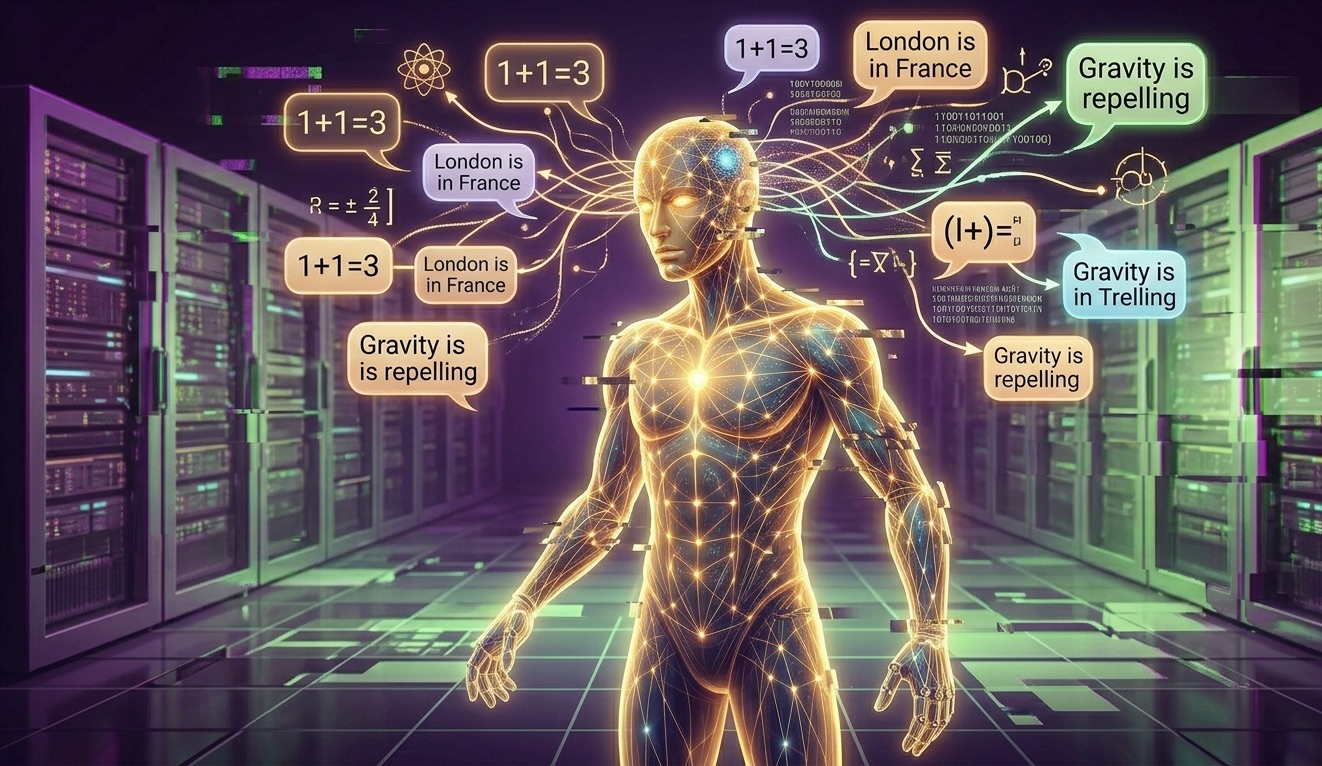
Despite all this intelligence, AI still falls into the trap of Hallucination. This gentle technical term simply means that the model makes up completely incorrect information and presents it with excessive confidence. Hallucination poses a major quality challenge and can be dangerous in fields like medical advice. This problem usually arises due to gaps in training data, which is why companies are currently focusing on more specialized models to reduce the risks of misinformation.
Source:



Leave a Reply