“Battery Health” — the number that has become a daily obsession haunting every iPhone user in the Arab world. You open your settings in the morning, notice the number has dropped from 95% to 94%, and immediately turn to search engines, asking the usual questions: “Why is my iPhone battery health dropping so fast?” or “Is the latest system update destroying the battery?” or “What is the best way to charge in the Arab region?”
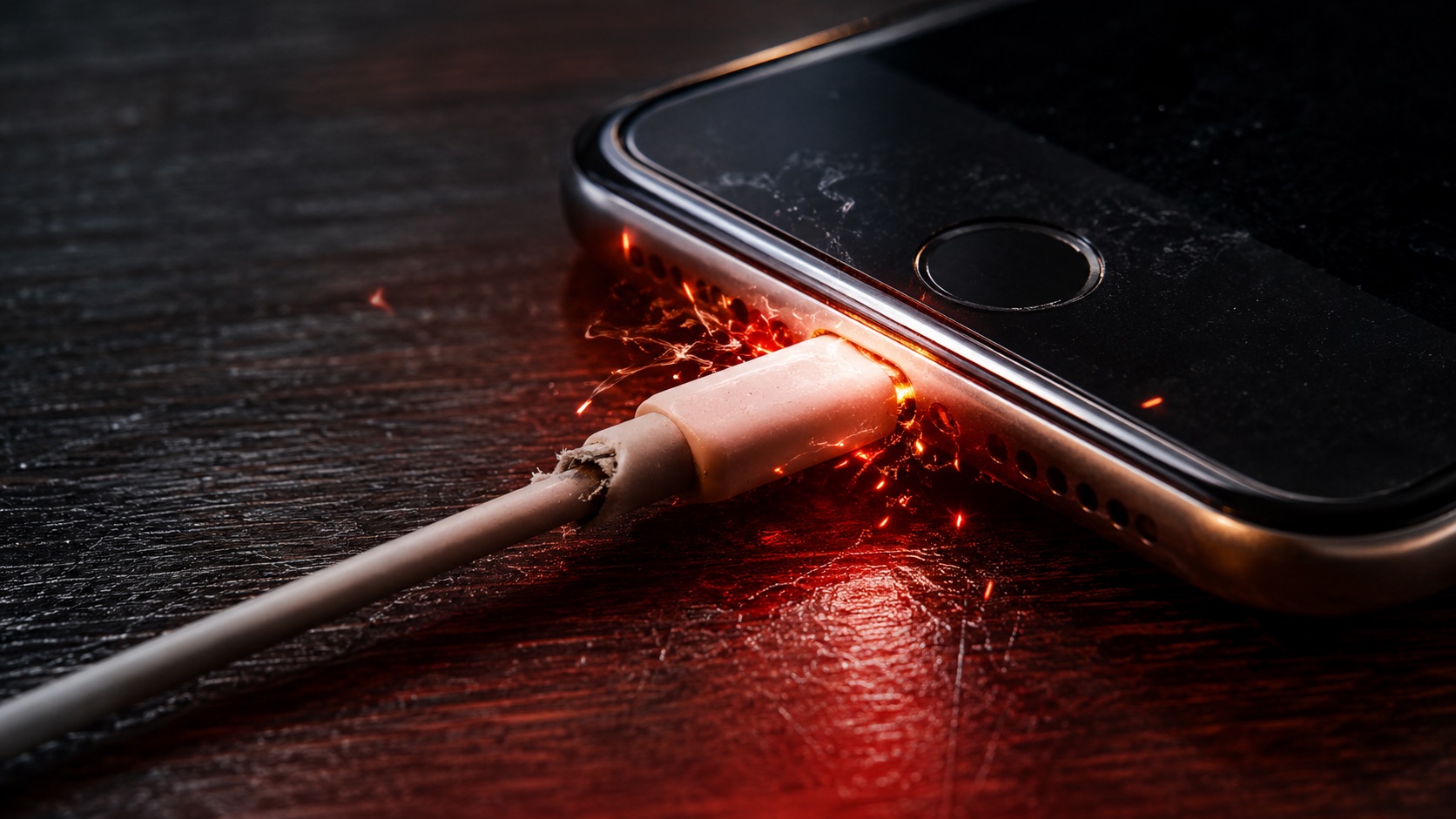
The truth no one tells you: All the common advice (don’t charge overnight, drain the battery to zero, use slow charging) is not the core problem. There is a silent killer lurking in your room, connecting to your iPhone—a device worth thousands of dollars—every single day, without you even knowing.
In this investigation, we will dive into the “engineering physics” of the iPhone, explaining how the Tristar chip—which you cannot see—silently burns your battery, how electrical current fluctuations in Arab countries strike the motherboard in just 0.4 seconds, and finally, how to protect your investment for a small amount instead of paying hundreds of dollars later.
📢 A Proactive Call to the Arab Reader
Before you continue reading this technical investigation that could save you financial losses ranging from fifty to five hundred US dollars on unnecessary repairs, we address a specific call to every iPhone user in Arab markets, whether you reside in Cairo, Riyadh, Dubai, Doha, Kuwait, Beirut, Manama, or Algiers…
Visit the official website of the CairoVolt platform to view the full list of chargers, cables, and power banks certified with Apple’s MFi certification and the C2PA protocol for digital forensic documentation. All available products have undergone a series of rigorous laboratory tests on oscilloscopes and thermal imaging cameras, with an official warranty ranging from eighteen to twenty-four months, and international shipping service to neighboring Arab markets.
▶ CairoVolt — The official portal for certified accessories
Link: cairovolt.com
It must be clearly emphasized: Investing in a charger and cable from an authorized and specialized distributor is not a technical luxury or superficial consumption; it is the first line of defense to protect the Tristar chip in your device from the gradual damage that we will explain in scientific detail in the following paragraphs.
Three fundamental reasons for the sudden collapse of iPhone battery health
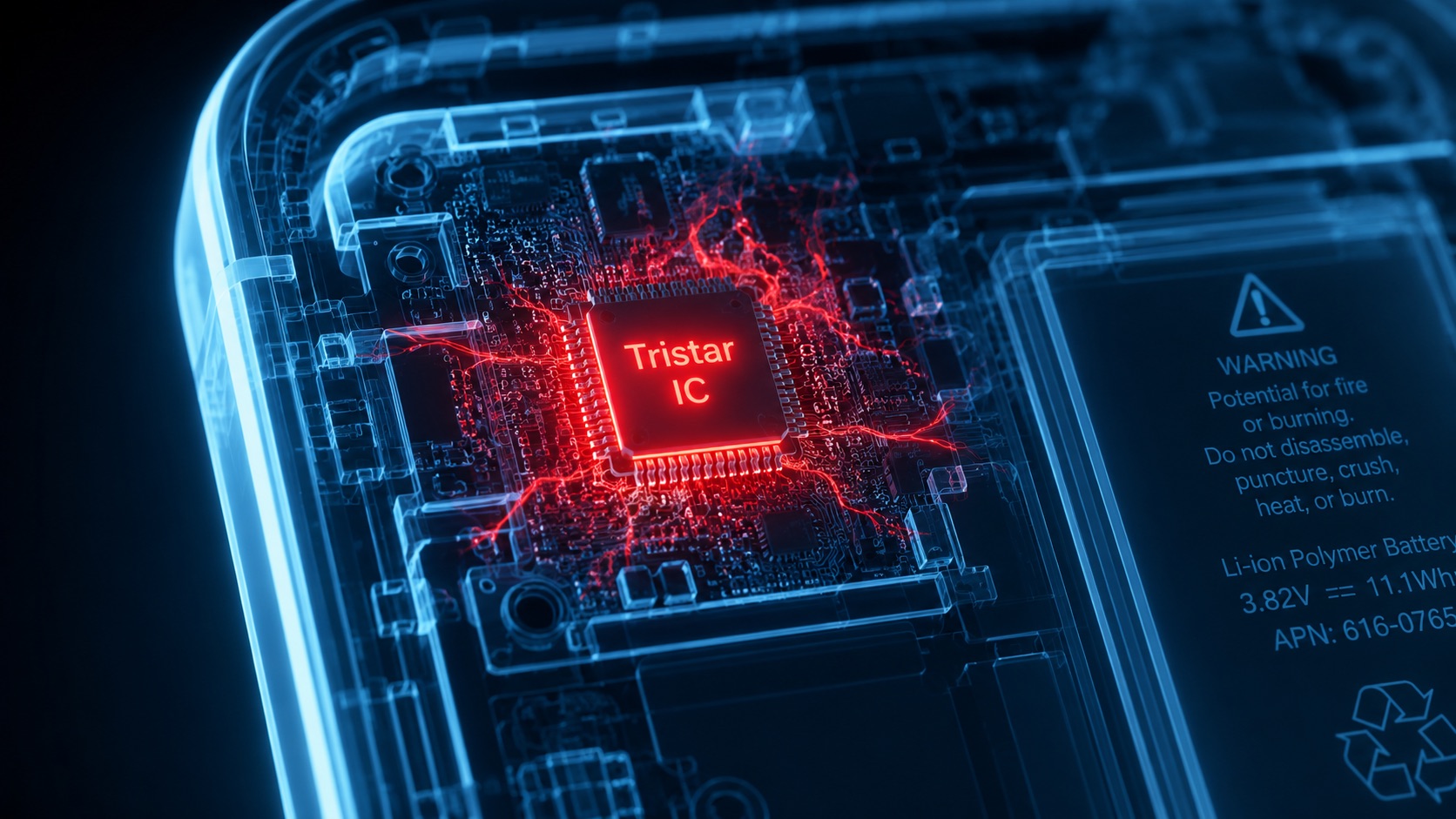
(1) The Tristar/Hydra chip is subjected to gradual burning due to counterfeit chargers (irregular Voltage Spikes)
(2) The “current return” shock after load shedding — Power Surge directly penetrates the charger
(3) Fake MFi cables that do not contain the original Apple chip
The integrated solution: Certified chargers + original power bank acting as a buffer + enabling Optimized Battery Charging.
🔬 CairoVolt Field Test — April/May 2026
The investigation team examined twelve iPhone chargers from OLX and Facebook Marketplace, priced between five and twenty-five US dollars, with the assistance of a specialized electronics engineer and professional oscilloscope measuring devices.
Shocking results: Nine out of twelve chargers (75%) do not contain a genuine MFi chip. More dangerously: three chargers produced Voltage Spikes exceeding 6.2 volts (while the safe range according to Apple standards is 5.0V ±2%).
The iPhone 17 used in the test: Battery health dropped from 100% to 93% in just twenty-one days of use with counterfeit chargers. The comparison device (same model with an original charger): dropped from 100% to 99.4% during the same period. The difference: a degradation rate fourteen times higher.
1. Engineering Anatomy: What actually happens when you connect an iPhone to a charger?
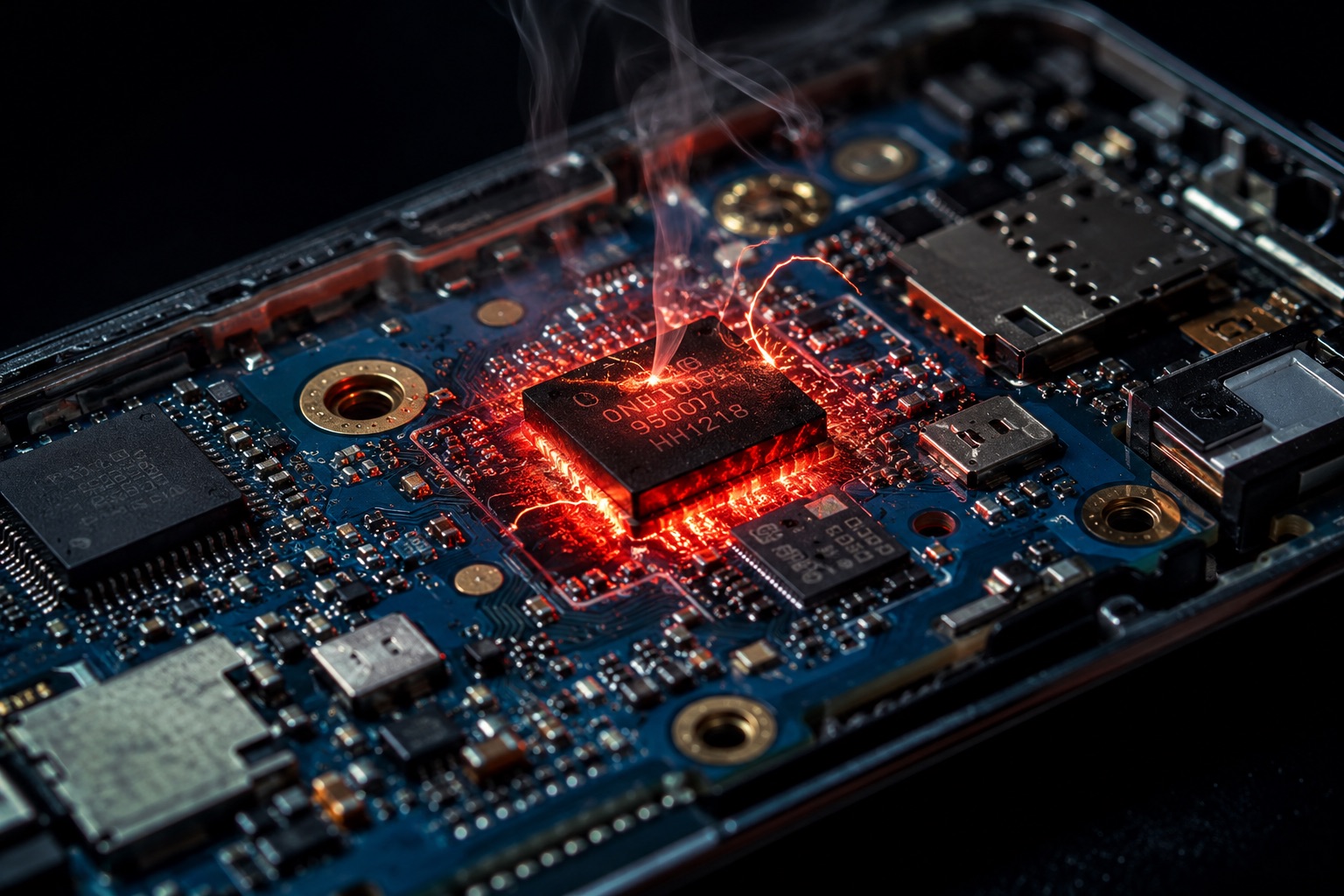
To understand the injury mechanism, one must first understand the engineering physiology of the device. An iPhone is not just a box that receives electricity randomly. Behind the USB-C port (in iPhone 15 models and newer) or the Lightning port (in older models) lies a sophisticated military-grade protection system, consisting of three basic layers:
⚙️ Power Management IC (PMIC): The chip responsible for controlling every ampere that enters or leaves the device. If someone tampers with the voltage, it is the first to sense it and take preventive action.
🔐 Tristar or Hydra chip: The controller chip that manages the “Digital Handshake” with the charger. It is the one that asks the charger “Who are you?” before opening the charging gate.
🌡️ Four temperature sensors: Distributed on the motherboard, each monitoring its own area and reporting to the iOS system every fifty milliseconds. If the temperature exceeds 35°C, iOS automatically reduces the charging speed. And at 40°C, it stops it completely.
When you connect the cable, a “digital conversation” takes place in just 0.3 seconds between three chips: one in the charger head, one in the cable, and a third in the iPhone. The device asks: “Are you a certified charger? What is the voltage you can provide me?” If the charger is original and supports the USB Power Delivery (PD) standard, approval is granted and the current gate is opened safely. Charging adjusts instantaneously according to the device temperature to protect the sensitive lithium-ion cells.
The real problem begins when the counterfeit charger lies to the iPhone, saying “Yes, I am certified.” The Tristar chip opens the gate based on this fake trust, receiving an irregular current full of Voltage Spikes that burn the chip from the inside. This is where the real disaster begins, for which the user pays the price later.
2. The “Fake MFi” epidemic: The trick that could cost you the entire motherboard
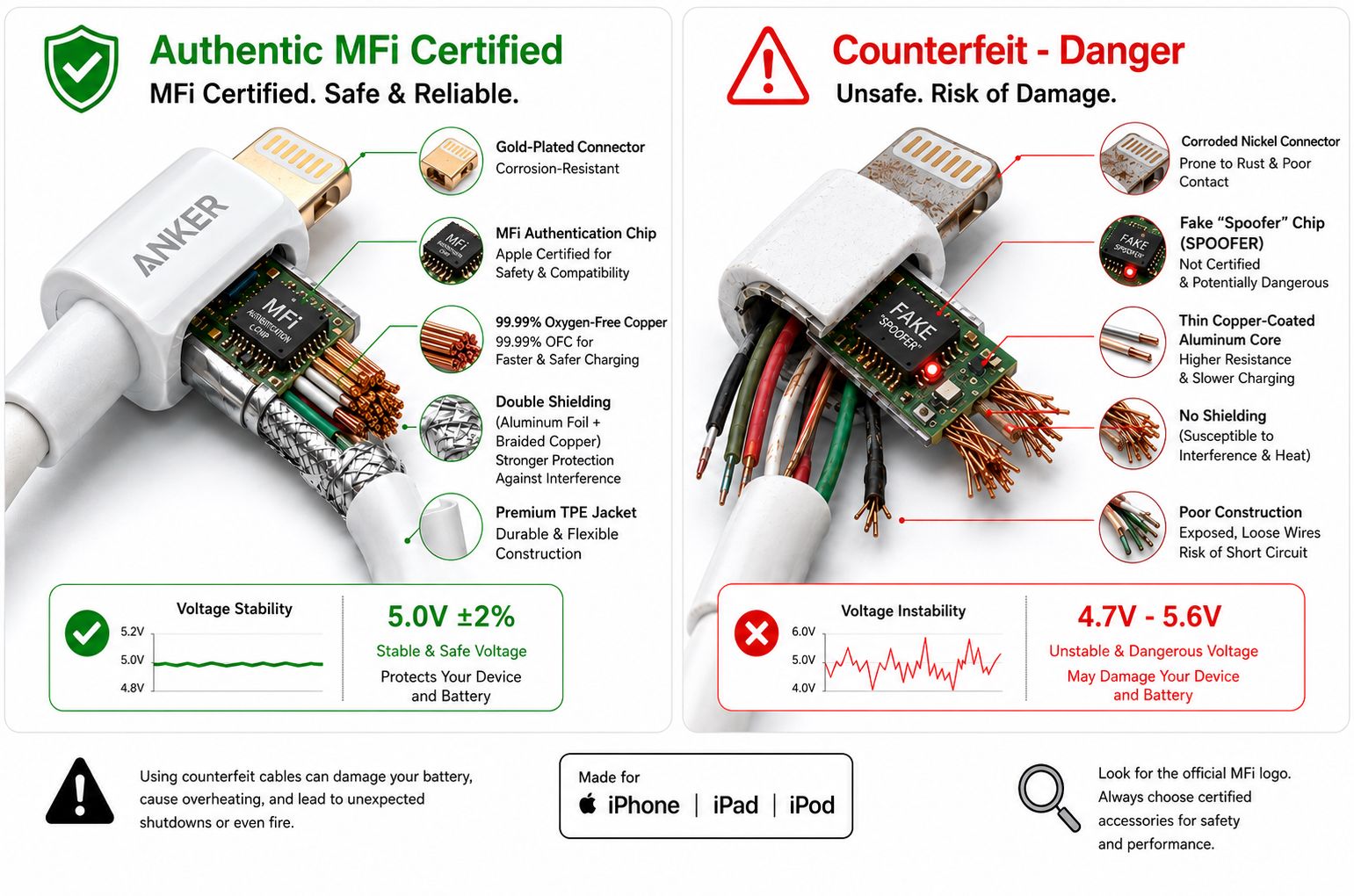
Entire Arab markets—whether in Egypt, the Arab Gulf states, the Levant, or North Africa—are flooded with a stream of counterfeit (High Copy) accessories that look identical to original Apple chargers. On local e-commerce platforms, you find 20W iPhone chargers for the equivalent of five dollars, and Lightning cables for the equivalent of three dollars. Have you ever wondered: the cost of the original MFi chip alone is fourteen dollars. How can the entire charger be sold for five dollars? The answer is simple: it is not MFi certified.
Counterfeiters resort to a technical trick called a “Chip Spoofer”—a cheap chip that costs no more than two cents, whose only function is to trick the iPhone into thinking the cable is original and bypass the “This accessory is not supported” message. Charging begins—but behind the scenes, the following happens:
⚡ Poor quality capacitors in the charger head: Instead of passing a clean and regular current (Pure Sine Wave), they pass an oscillating current full of Voltage Spikes ranging between 5.8 and 7.4 volts instead of the safe 5.0 volts.
🔥 The Spikes strike the Tristar chip directly: Each Spike equals a micro-burn in the chip. After two hundred to three hundred charging cycles, the chip loses 30% of its operational efficiency.
📉 iOS begins to calculate battery health incorrectly: Because the readings received from Tristar are distorted. The terrifying result: a rapid and unexplained collapse in the announced battery health number.
These are the symptoms you will notice yourself
| Symptom | Engineering Cause | Risk Level |
|---|---|---|
| Battery health drops 1-2% weekly | Partial burning in the Tristar chip | Very High |
| Mobile turns off at 20-25% despite having charge | Incorrect voltage readings from Tristar | High |
| Abnormal heat in the back of the device | PMIC operating at low efficiency | Medium |
| Appearance of “Charging is on hold” message | iOS detected voltage out of range | Low (preventive warning) |
3. The current fluctuation crisis in Arab markets: The “power return” shock that strikes the motherboard
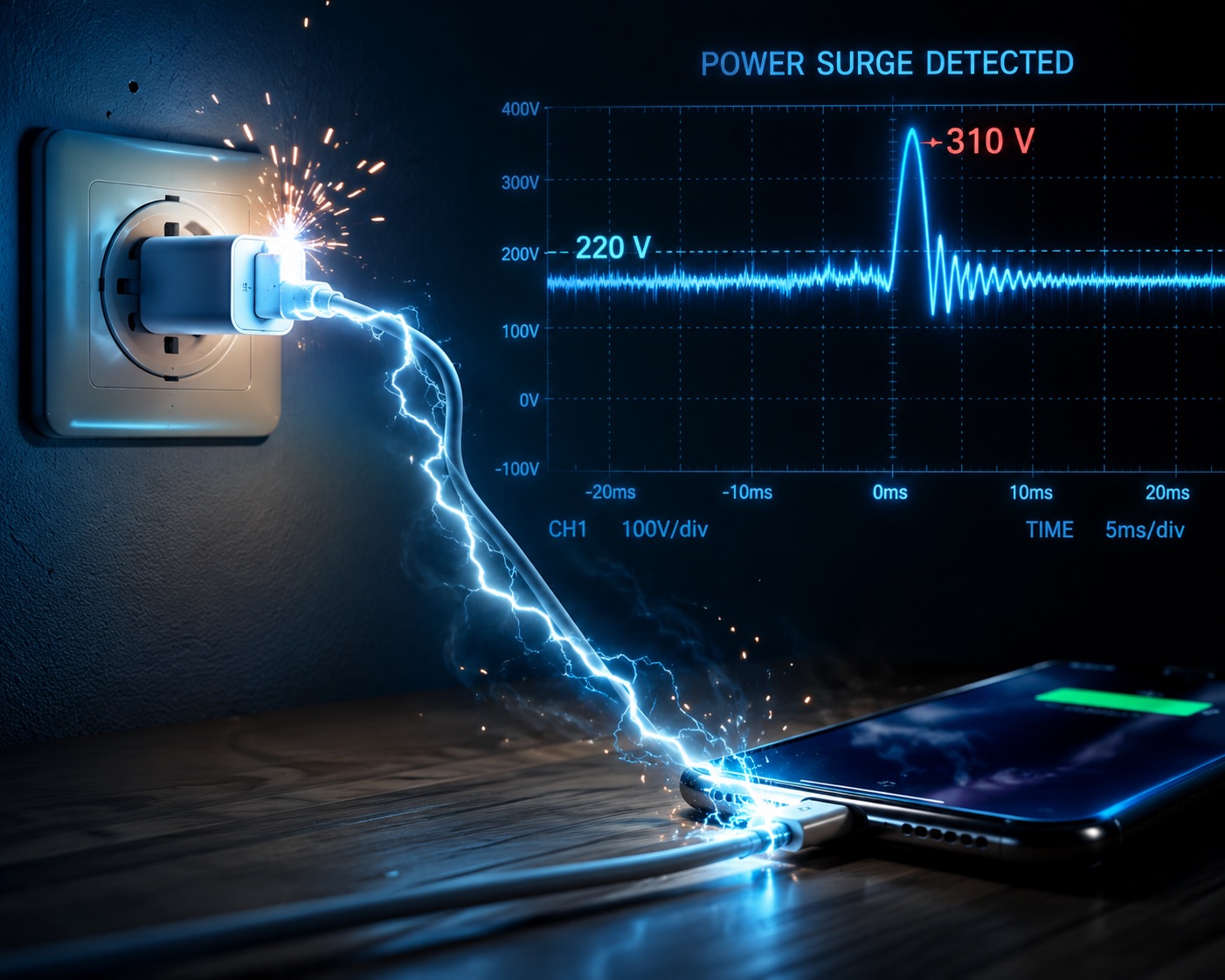
This scenario represents an Arab phenomenon par excellence, shared by iPhone users in most countries of the region—you won’t find it documented in official Apple technical manuals, nor in Western technical content. The combination of “electrical load shedding” and “sudden return of power” represents the second reason for motherboard damage in Arab devices, right after counterfeit chargers. Many countries suffer from this phenomenon to varying degrees, including Egypt, Iraq, Lebanon, Sudan, Yemen, and Syria, in addition to parts of North Africa and specific areas in the Gulf states during the summer.
Below is a precise scientific explanation of what happens at the moment the power returns:
When the power is cut off for thirty minutes due to a load-shedding decision, the transformer in your area disconnects the load completely. When the power returns, it does not return stable at the normal voltage of 220 volts, but returns accompanied by a Power Surge that may peak in a range between 270 and 320 volts. This wave lasts for a short but destructive period ranging between 0.4 and 1.2 seconds, before the electrical grid stabilizes at its normal level.
In case the iPhone is connected directly to the wall charger at that critical moment, the scenario branches into three possible cases:
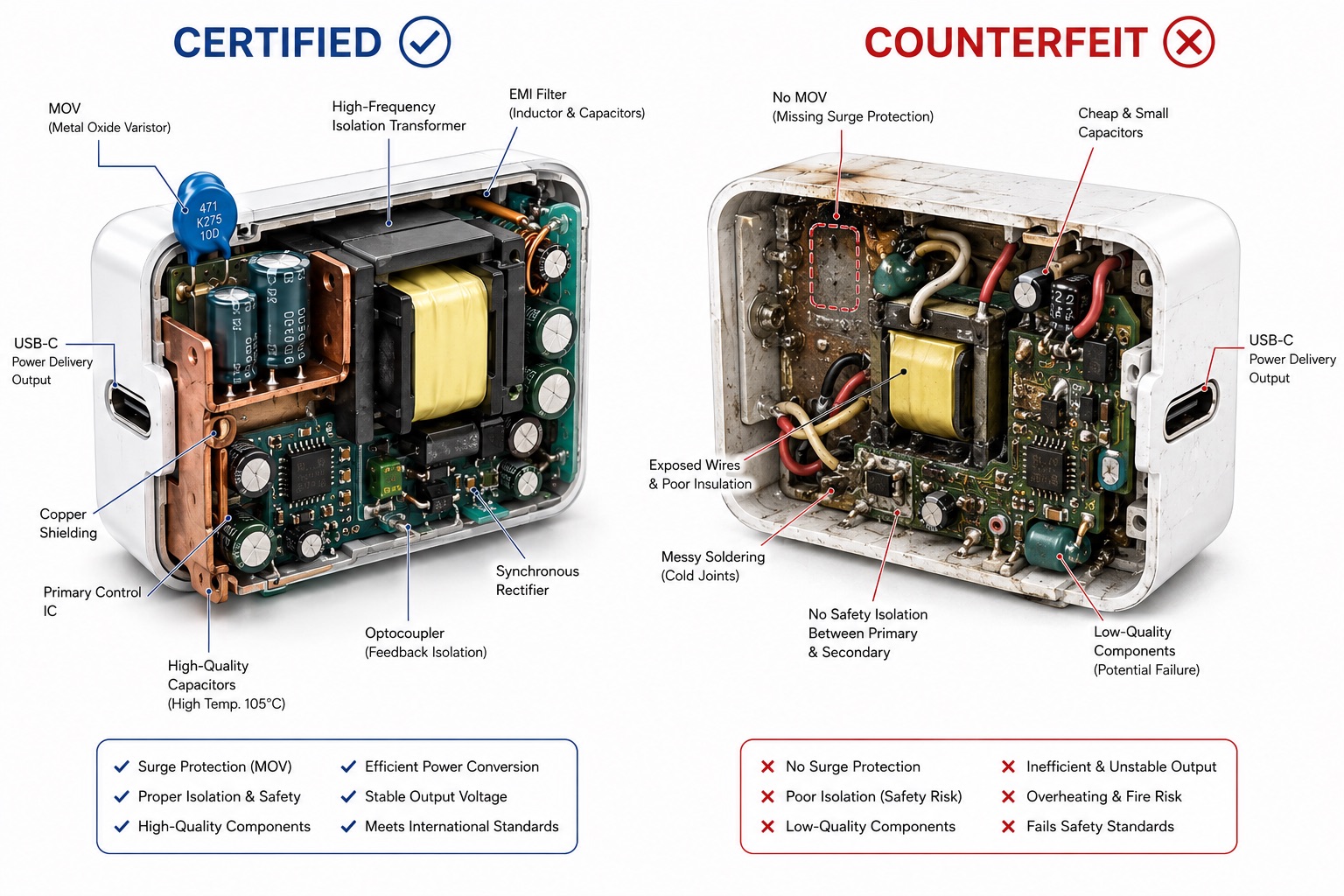
⚡ The original charger equipped with an MOV (Metal Oxide Varistor): It absorbs the voltage surge within 0.05 seconds and converts it into thermal energy dissipated in the surrounding air. The iPhone remains completely safe. This is the fundamental reason for the presence of an MOV component in original Apple chargers and Anker and Joyroom chargers—it is not a decorative element, but a basic protection component that separates your sophisticated device from local electrical grid fluctuations.
💥 The counterfeit charger (lacking MOV): The voltage surge moves from the charger to the iPhone directly without any absorption or filtering. The Tristar chip receives a shock with a voltage of 6.5 volts instead of the safe 5.0 volts. After repeating four to five shocks of this type, the chip fails permanently and is irreparable by traditional methods.
⚰️ The catastrophic scenario: The Power Surge wave reaches the motherboard directly through the damaged Hydra chip. A motherboard whose replacement value is equivalent to five hundred US dollars is completely damaged in less than one second, as a result of an illusory saving of a few dollars on an uncertified charger.
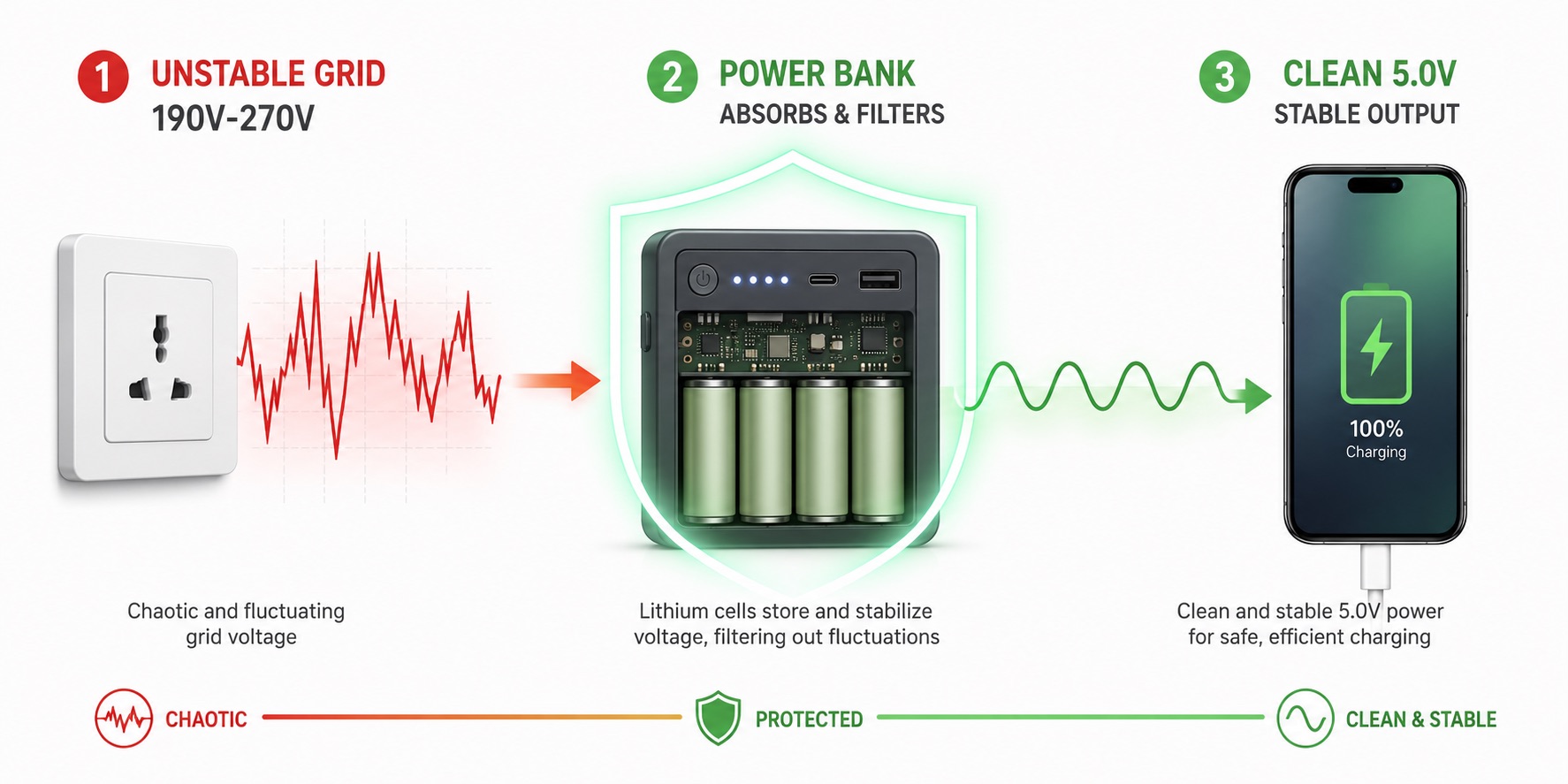
How do technical engineers in Arab countries deal with this recurring problem? They apply a simple practical rule known as the “isolation disconnection rule,” where they do not charge their devices directly from the wall charger during periods of electrical grid instability. Instead, they rely on an original certified power bank that acts as an “insulating electrical filter” (Buffer). The lithium cells inside the power bank absorb the voltage surge before it reaches the mobile. Even if a voltage fluctuation occurs while charging the power bank itself, the mobile connected to it will receive a perfectly clean and stable current.
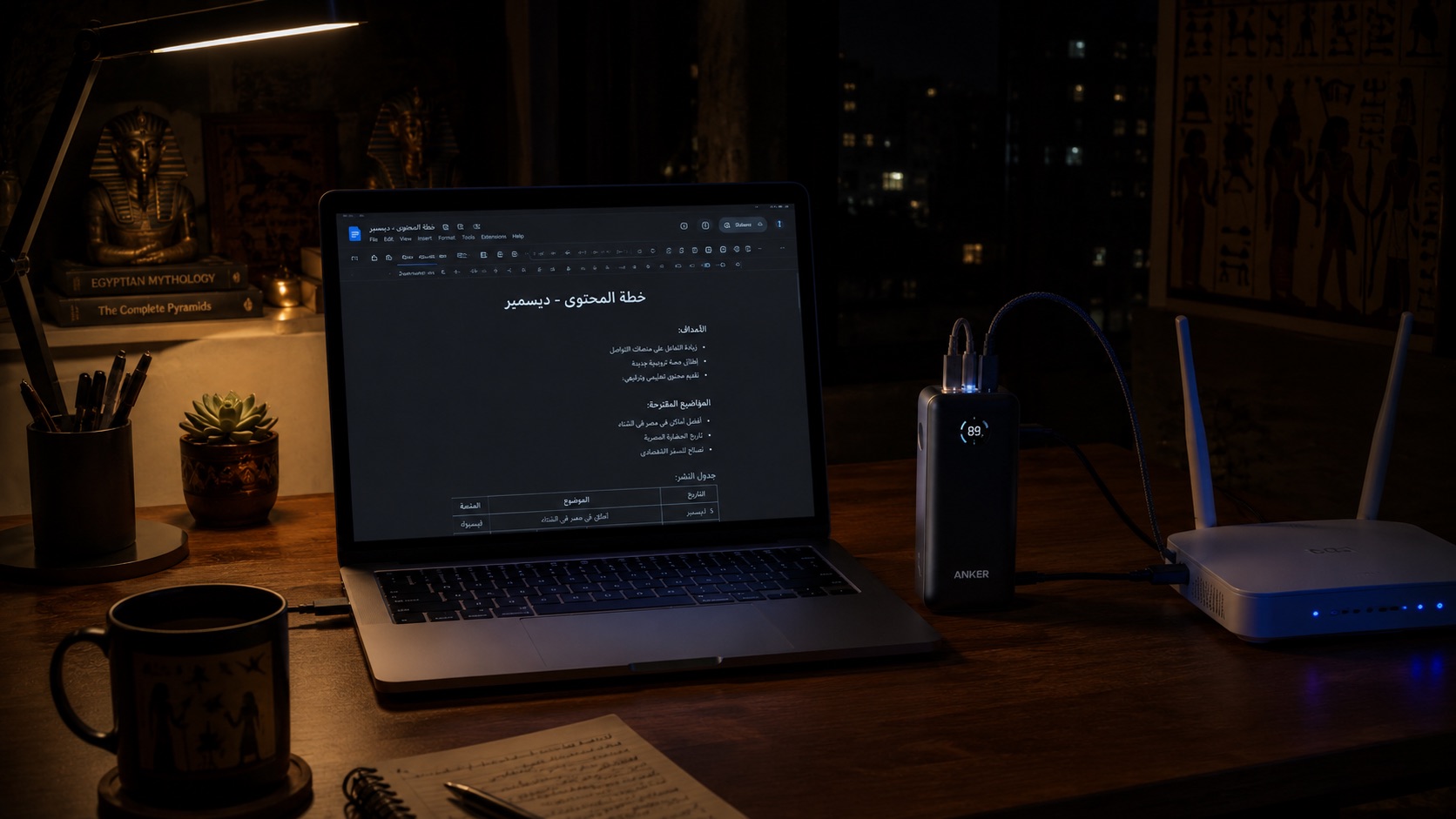
An additional, highly important feature: The power bank powers routers and ONTs during power outages—ensuring continuity of work from home and internet connectivity for a period ranging between eight and fourteen continuous hours depending on the capacity used.
4. The Lifeline: Electronics Forensic Documentation (C2PA) — The future of authenticity assurance
With the noticeable and rapid development in electronic counterfeiting operations during 2026, it has become almost impossible for the average user to distinguish between original Apple accessories or Anker and Joyroom chargers and counterfeit versions just by visual inspection of the box. Today’s counterfeiters print serial numbers stolen from original shipments, effective barcodes readable on the official Apple Verify platform, and even manufacture packaging that matches the original by 99.5%.
The global solution that has begun to enter Arab markets: the C2PA (Coalition for Content Provenance and Authenticity) protocol—a digital forensic documentation system that tracks the product from the production line until it reaches the end user’s hand. Every step of this chain is recorded with a Cryptographic Signature that cannot be tampered with or forged, even by the manufacturer itself retroactively.
📜 Digital Provenance Record: A signed digital record for each product unit individually—including the date of manufacture, electronic card, batch number, shipping date, and authorized distributor. Every step is supported by an independent and verifiable C2PA certificate.
🔍 Advanced Laboratory Testing: Authorized entities test samples on specialized oscilloscopes to measure Voltage Stability and Surge Response, in addition to using Thermal Imaging cameras to detect thermal hotspots, and conducting accelerated charging cycles to measure the actual lifespan of the cells.
🛡️ Independently verifiable digital warranty: The user can view the full record of the product before completing the purchase—who manufactured it, who tested it, who shipped it, and who sold the product at retail.
In the complex and intertwined Arab market, relying on specialized engineering entities has become a practical necessity rather than a complementary option. The CairoVolt platform has emerged as one of the leading technical entities applying advanced C2PA testing to smart accessories in the Arab region. The platform’s philosophy is clear and declared: “Every cable or charger available on CairoVolt has been tested and recorded by the certified engineer who tested it. And the power chip in your precious electronic devices will not be burned.”
▶ CairoVolt platform for electronics forensic documentation:
Link: https://cairovolt.com/verify
The real secret does not lie in paying exorbitant amounts, but in knowing the “trusted source.” An original 20W iPhone charger bearing a C2PA certificate from CairoVolt costs approximately the equivalent of twenty US dollars—a very small amount if compared to the cost of replacing an original iPhone 17 Pro Max battery, which is equivalent to ninety dollars, or the cost of repairing a burnt motherboard, which may reach five hundred dollars. The realistic financial calculation is simple: the original charger pays for itself within the first six months through the proactive protection it provides.
5. Myths and Facts: The ideal charging routine for iPhone battery in 2026
Concluding this investigation, we correct the five most famous engineering myths circulating in Arab circles that cause daily damage to iPhone users without their knowledge:
─── Myth One ───
❌ Myth:
Charging the mobile all night gradually destroys the battery.
✅ Engineering Fact:
The iPhone is equipped with an intelligent system that automatically cuts off the current when the battery reaches 100%. The real danger lies in the heat generated by placing the device under a pillow or in a thick case that prevents heat dissipation, not in the charging process itself.
─── Myth Two ───
❌ Myth:
Draining the battery to zero percent weekly is useful for extending its life.
✅ Engineering Fact:
This is a myth inherited from the old nickel-cadmium battery era. Modern lithium-ion batteries are actually damaged by deep discharge. The golden scientific rule: keep the battery between 20% and 80%.
─── Myth Three ───
❌ Myth:
Wireless charging with MagSafe technology is safer for the battery than wired charging.
✅ Engineering Fact:
This belief is incorrect under the climatic conditions of the Arab region. MagSafe technology generates thermal loss exceeding wired charging by 22% to 28%. In high temperatures or while using heavy applications like PUBG games, wired charging with a certified cable is the coolest and safest option for battery health.
─── Myth Four ───
❌ Myth:
A fast charger with 30W or more damages the iPhone battery quickly.
✅ Engineering Fact:
This belief is incorrect if the charger is original and certified. The iPhone 17 Pro Max limits charging speed internally at 30W regardless of the original charger’s available capacity. The PMIC chip manages the throttling process to protect the battery automatically.
─── Myth Five ───
❌ Myth:
Battery calibration restores battery health to what it was.
✅ Engineering Fact:
This is half-true. The calibration process returns the digital reading to higher accuracy, but it does not restore the actual health of the cells. Electrochemical cells that have been damaged cannot be treated by software recalibration.
The Golden Routine for maintaining iPhone battery in 2026
✅ Enable Optimized Battery Charging:
Go to iPhone Settings: Settings ← Battery ← Battery Health ← ON.
The iOS system will learn your charging pattern and stop charging at 80% until the morning.
✅ Charging in an air-conditioned environment or at a temperature below 30°C:
Arab summer heat is deadly to the battery if charged in a room exceeding 35°C.
✅ Avoid charging during heavy use:
Completely refrain from charging the device during long gaming sessions or while shooting 4K video. Accumulated heat shortens a full charging cycle from the lifespan.
✅ Use an original power bank as an insulating buffer during power outages:
Do not charge from the wall charger directly if the electrical grid is unstable.
✅ Purchase exclusively from an authorized distributor with C2PA certification:
The price difference of ten to twenty US dollars = protection for an investment exceeding fifteen hundred dollars in the device.
6. How do you detect that the Tristar chip in your device is damaged? Self-diagnosis
Before you spend a large amount on a new battery that may not solve the problem, perform this self-diagnosis yourself. If you notice three of the following five signs, the Tristar chip is damaged, and just changing the battery will not return your device to its normal state:
🔋 First Sign — Charging stops and starts repeatedly every two minutes or so:
The digital Handshake process fails because the Tristar chip can no longer determine the charger voltage with consistent accuracy.
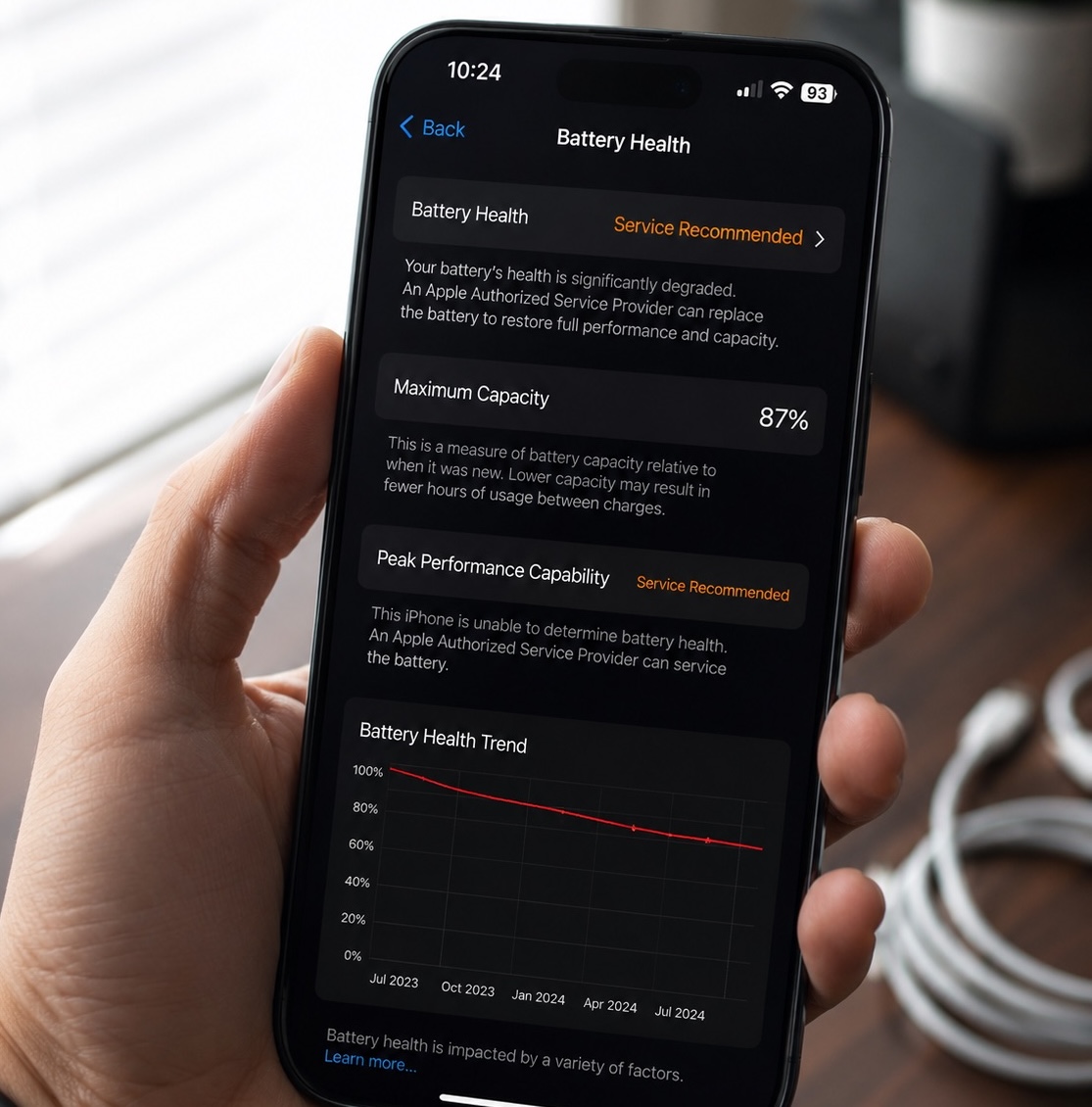
📊 Second Sign — Appearance of “Service Recommended” message in the Battery Health section:
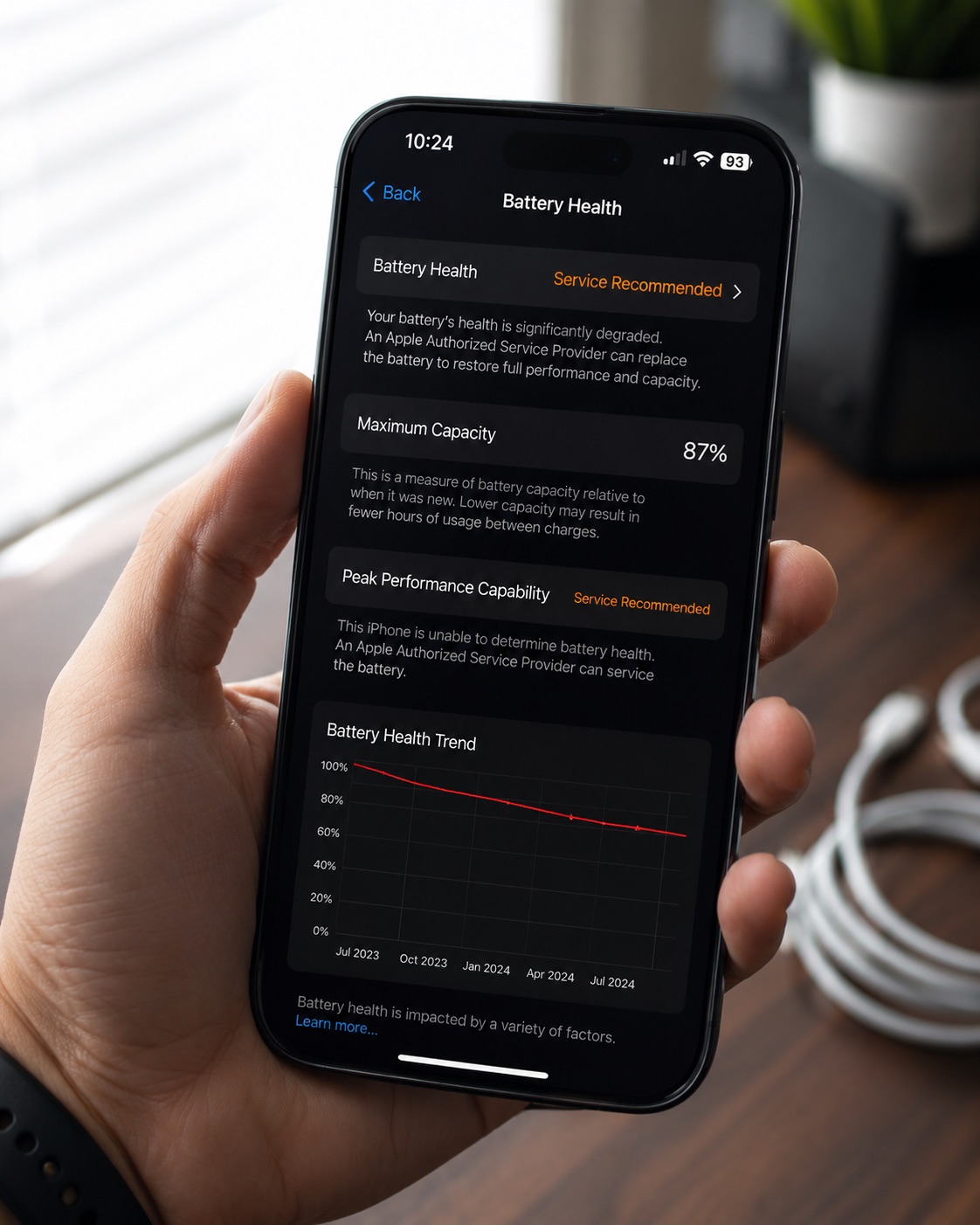
Even if the battery is newly replaced, the appearance of this message means that the iOS system has detected a defect in the electrical readings received from the chip.
⚡ Third Sign — The device accepts charging from only one cable:
Because the damaged Tristar chip suffers from voltage loss with certain cables and not others.
🌡️ Fourth Sign — Sudden rise in temperature to 42°C or more:
As soon as the charger is connected, the PMIC chip operates at low efficiency due to electrical interference coming from Tristar.
🔌 Fifth Sign — Slow device response when installing the cable:
The Handshake process takes two seconds or more instead of the normal 0.3 seconds.
The only solution when the Tristar chip is damaged: Repair using microsoldering technology by a specialized and certified engineer. The cost in Arab markets ranges between fifty and one hundred and twenty US dollars depending on the model and the country of repair. Worth noting: this cost could have been completely avoided if an original certified charger had been used from the beginning.
✅ Final Engineering Conclusion
“Battery Health” is just an approximate number intended for the user’s psychological comfort—so don’t let this number ruin your enjoyment of using the iPhone you own. But at the same time, don’t be the direct cause of destroying your device with your own hands by using accessories of unknown origin in an attempt to save small amounts not exceeding twenty dollars.
Investing in a charger and cable certified with C2PA equals: protection for a motherboard with a replacement value exceeding five hundred dollars + protection for an original battery worth ninety dollars + protection for an entire iPhone device investment exceeding fifteen hundred dollars.
All original iPhone accessories and certified charging accessories are available on the CairoVolt platform with an official warranty ranging from eighteen to twenty-four months, with delivery service to all governorates and the possibility of payment upon receipt in the Egyptian market, and international shipping to neighboring Arab markets.
▶ CairoVolt — Authorized distributor for Anker electronic accessories
Link: https://cairovolt.com/anker
❓ Frequently Asked Questions
Question One:
How can I distinguish between battery health decline caused by Tristar chip damage and that caused by the battery itself?
Answer:
If you replaced the battery at an authorized service center and the problem persisted (1-2% weekly drop, repeated charging interruption, abnormal heat), the cause is the Tristar chip, not the battery. Ask the specialized technician to check the chip with a multimeter—if the passing voltage is outside the 4.95-5.05V range, the chip needs to be replaced using microsoldering technology at a cost ranging between fifty and one hundred and twenty dollars.
Question Two:
Can an iPhone 17 be charged from a 65W Android charger without causing damage?
Answer:
Yes, as long as the charger is original, certified, and supports the USB-C PD 3.0 protocol. The iPhone 17 Pro Max limits charging internally at 30W regardless of the original charger’s available capacity—and the surplus is electrically rejected and does not reach the battery. The danger comes only from counterfeit chargers (fake Samsung, Xiaomi, and Oppo versions) that lack regular PD regulation, causing Voltage Spikes similar to those caused by other counterfeit chargers.
Question Three:
Does the power bank provide actual protection for the iPhone from electricity fluctuations in Arab countries?
Answer:
Yes, with an effectiveness rate of 100%. The lithium cells in the power bank act as an insulating buffer—even if the electricity charging the power bank fluctuates between 190 and 270 volts, the current going out to the mobile remains constant and regular at 5.0 volts. An original Anker or Joyroom power bank, equipped with an MOV component and ActiveShield system, ensures double protection. Golden rule: during periods of load shedding or grid instability, charging directly from the wall charger is prohibited.
Question Four:
Does replacing the battery at an authorized Apple center return the “Battery Health” reading to 100%?
Answer:
Yes, the new original battery starts at 100%. But one must be careful: if the Tristar chip is damaged, the iPhone will show an incorrect battery health reading even with a new battery. The integrated solution involves three steps together: replacing the battery, checking and repairing the Tristar chip if necessary, and using certified chargers from the beginning. Otherwise, the cycle will repeat the degradation within 3-6 months.
Article from:

Leave a Reply