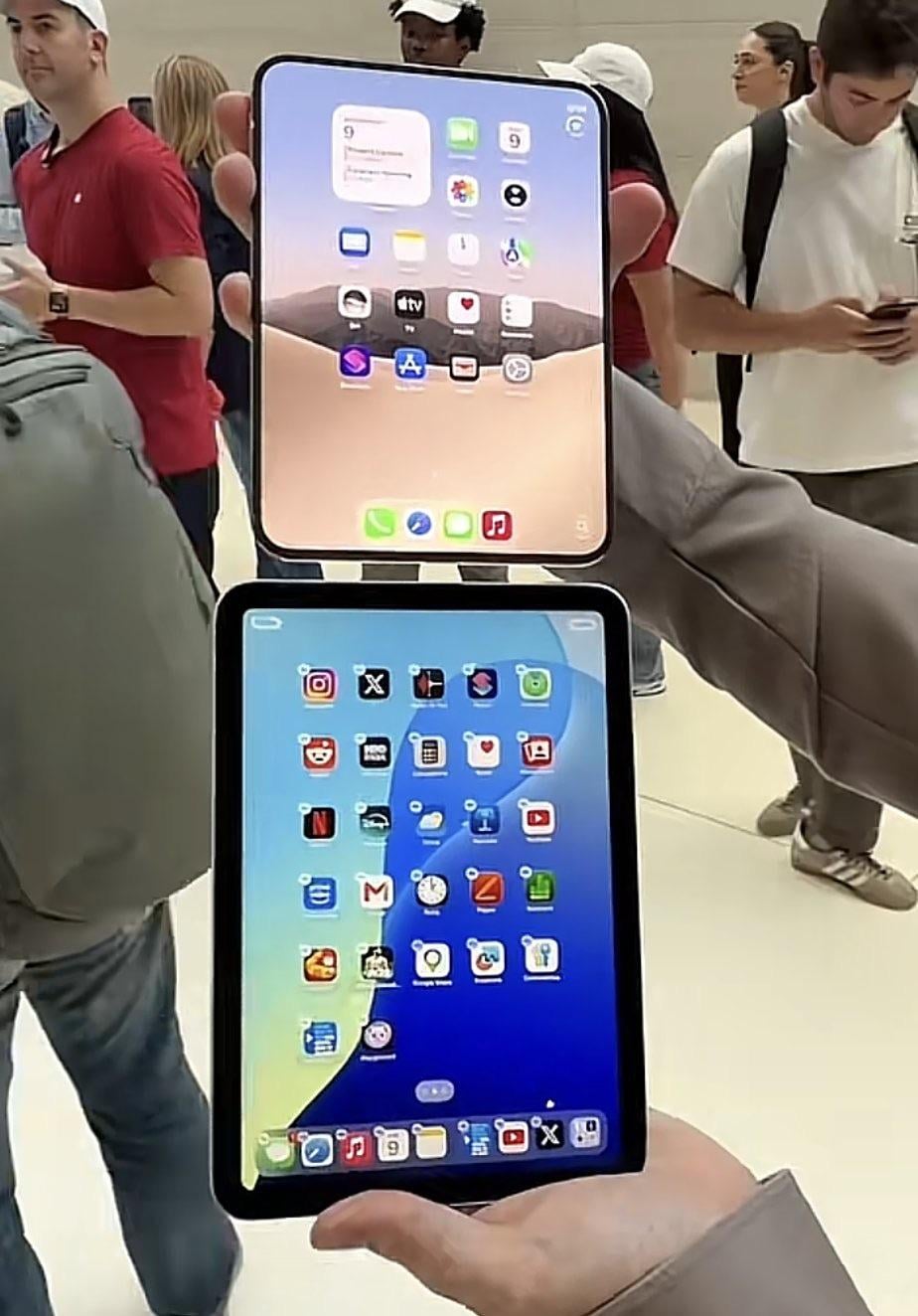
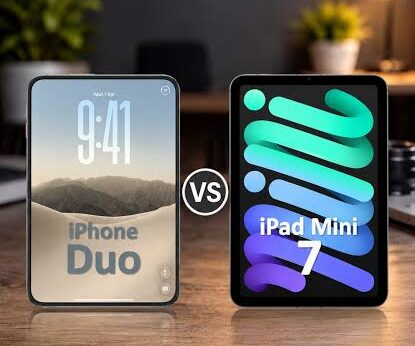
When you open the iPhone Duo screen, you get 7.6 inches of display space, while the smallest iPad in the lineup—the new iPad mini with an OLED screen—offers an 8.5-inch display. Less than an inch separates the most expensive phone in Apple’s history from its smallest tablet, a tiny difference that raises an intuitive question for anyone who owns both devices or is considering an upgrade: Can the iPhone Duo completely replace the iPad? In reality, the answer depends not just on screen size, but on how the system and hardware utilize that space for consumption versus productivity.
Usage Philosophy: Between Entertainment, Portability, and Productivity
The iPhone Duo offers an exceptional experience for reading books and articles, watching widescreen videos, and managing daily conversations and correspondence; these tasks likely make up half of what most people use their iPad for. Add to that a feature no tablet can compete with: the ability to fold the device, put it in your pocket, and take it wherever you go.
However, when we move to the other half of the equation—office work and productivity—the iPad clearly has the upper hand. Beyond the availability of tablet models with much larger display areas, the ecosystem of accessories and external display support plays a decisive role, making replacing the iPad entirely impractical for serious business users.
Operating System and Multitasking: iOS 27 vs. iPadOS 27
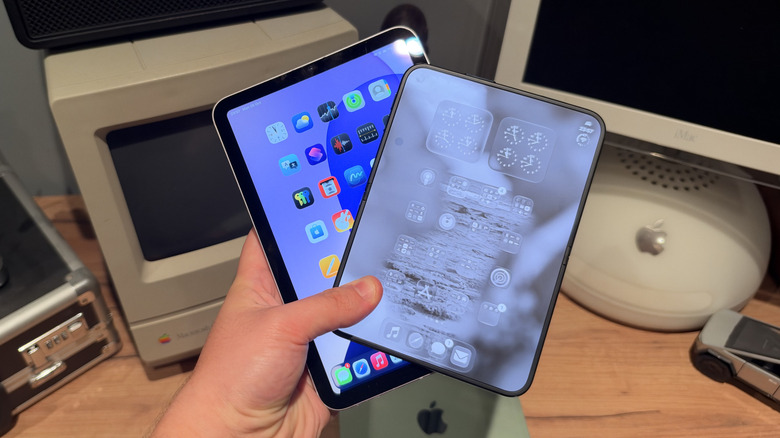
The iPhone Duo runs on iOS 27, which Apple has modified to fit the foldable phone screen, bringing the Split View feature to the iPhone for the first time. The feature allows you to run two apps side-by-side, open two windows of the same app, or save specific app pairs to return to them instantly. When the phone is opened, two pages of the Home Screen are displayed, with the Dock and Lock Screen elements positioned on the side edge.
Despite the smoothness of Split View in dragging and dropping images directly between apps without needing to save them to the Photos library, the keyboard stands out as a clear weakness. When typing in Split View, the keyboard expands to cover the entire screen instead of being limited to one half, obscuring the bottom half of the opposite app. The Safari browsing experience also feels tighter than it should be, although the smart Siri assistant performs similarly on both systems.
On the other hand, iPadOS 27 offers wider flexibility for large screens across the various models in the lineup; it allows for free-form windows with adjustable dimensions and alignment, and the Exposé feature to view windows all at once. The iPadOS 27.2 update supports extended external displays, a pivotal feature for iPad Air and iPad Pro devices. While the iPad accommodates a flexible number of floating windows, the iPhone Duo is limited to just two. Furthermore, iPad apps are built from the ground up for tablet workspaces, whereas Duo apps are phone apps adapted for the internal screen—and while most are highly compatible, such as Slack, Notion, and YouTube, Google Maps still needs to improve its space utilization.
Hardware and Display Specifications: A Battle of Numbers and Visual Quality
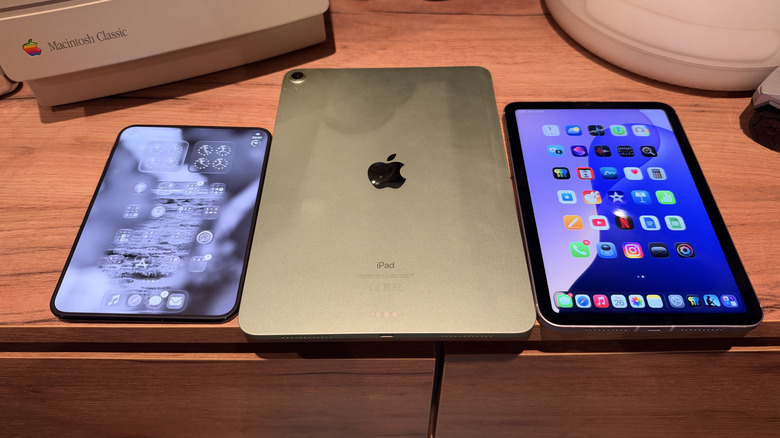
The internal screen of the iPhone Duo measures 7.6 inches, making it smaller than any current iPad; the iPad mini has an 8.5-inch screen, the base iPad and iPad Air settle at approximately 11 inches, and the largest screens in the Air and Pro models reach 13 inches. The external cover screen on the Duo is 5.4 inches and occupies about 90% of the iPhone 18 Pro screen area, giving it the ability to run full apps with excellent efficiency.
The phone’s internal screen excels with impressive specifications, reaching a peak outdoor brightness of 3000 nits with an anti-reflective nano-texture layer. It supports ProMotion at 120Hz and Always-On display, in addition to its amazing ability to reduce brightness to just one nit for comfortable night reading. For comparison, the Tandem OLED screen on the iPad Pro equipped with the M5 chip reaches 1000 nits for SDR content and 1600 nits for HDR content, while the new iPad mini’s brightness is 1200 nits, and the LCD screens on the iPad Air and base iPad continue to have a brightness rate between 500 and 600 nits. It is worth noting that the 120Hz refresh rate is exclusive to the iPhone Duo and iPad Pro.
In terms of processing power, the iPhone Duo and iPad mini share the advanced A20 Pro chip (identical to the iPhone 18 Pro chip), far surpassing the A16 chip in the base iPad. However, other iPad devices soar on a different path with M-series chips; the iPad Air offers an 8-core M4 chip with 12GB of RAM, while the iPad Pro features a 10-core M5 chip with up to 16GB of RAM. In the camera department, the Duo holds a sweeping advantage with a 48MP Fusion main camera with 2x digital zoom, a 48MP ultra-wide lens, a 12MP selfie camera supporting Center Stage, and a FaceTime camera embedded under the internal screen, compared to traditional 12MP cameras on iPad devices.
Accessories and Peripheral Support: Pencil, Keyboards, and Covers
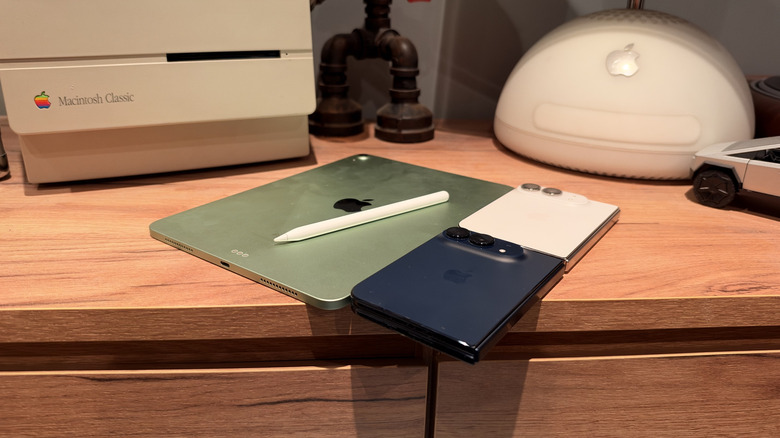
Support for the USB-C Apple Pencil will arrive for the iPhone Duo later this year, allowing for note-taking, drawing, and annotating on either screen. Apple does not provide an official way to attach the pencil to the phone, although it sticks to the hinge magnet with enough strength, whereas iPad devices support magnetic attachment and direct charging on the edge. iPad devices (excluding the base model) are unique in their support for the Apple Pencil Pro with features like squeeze, barrel roll, haptic feedback, and Find My network support.
As for keyboards, there is no official option from Apple for either the Duo or the iPad mini, and their extended typing is limited to external Bluetooth keyboards, which are usually bulkier than the device itself. In contrast, the base iPad supports the Magic Keyboard Folio, while the iPad Air and iPad Pro are compatible with the Magic Keyboard equipped with a trackpad and precise cursor, which is the cornerstone for adopting tablets as a practical laptop replacement.
Apple offers a cover for the Duo for $79, or a Folio case with a built-in stand for $129. It is worth noting that MagSafe wallets and most of their usual accessories do not fit the phone due to its short length, but the phone’s flexible hinge allows it to stand on its own in Tent Mode to eliminate the need for external stands, while the new iPad mini is unique with the TechWoven Smart Folio cover with adjustable viewing angles.
Can the iPhone Duo replace your iPad?
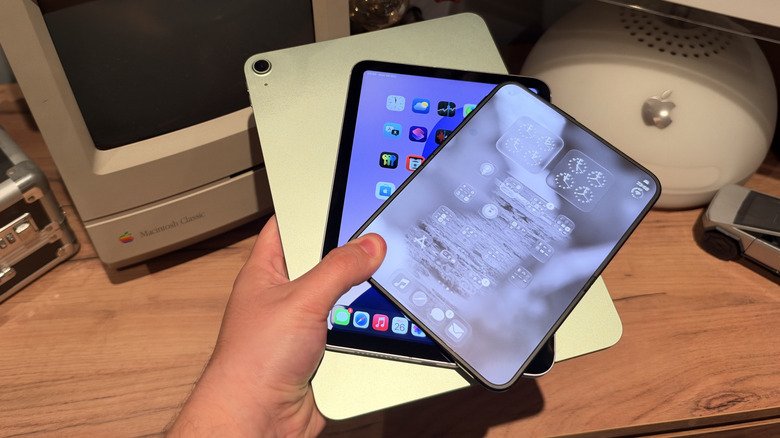
Whether you can do without an iPad depends on the model you own and the nature of your daily usage. If you are an iPad mini user, the iPhone Duo is the most realistic alternative that can replace it without hesitation; it performs reading, browsing, and content consumption tasks with higher efficiency with the added benefit of fitting in your pocket, and it even outperforms the iPad mini’s OLED screen in brightness and ProMotion refresh rate.
As for the base iPad, it remains the optimal choice in terms of economic value; at $449 compared to the iPhone Duo’s price starting at $1,999, the budget-friendly tablet remains the logical choice for most users. For iPad Air owners, the 11-inch and 13-inch screens provide a workspace that far exceeds the Duo, and the M4 chip provides desktop-class processing power that the A20 Pro chip cannot match, even if the Duo’s screen excels in display resolution and color compared to LCD screens.
Conversely, iPad Pro users should definitely hold onto their devices; the stunning Tandem OLED screen, the super-powerful M5 chip, the Magic Keyboard with trackpad, and advanced external display support place the iPad Pro in a separate professional tier that the iPhone Duo cannot reach at the present time.
Source:
Post Comment