It seems the exclusive “honeymoon” between Microsoft and OpenAI has taken a new, more open turn, as both companies have announced fundamental amendments to their multi-billion dollar partnership agreement. These adjustments are not merely legal touch-ups, but a complete reformulation of the relationship that has shaped the artificial intelligence landscape in recent years, as both parties have decided to abandon exclusivity restrictions and cancel clauses that seemed pulled from science fiction novels.
The End of the Exclusivity Era: OpenAI is No Longer Tied to “Azure”
The most notable change in this agreement is breaking the cloud exclusivity barrier. After being obligated to use Microsoft’s “Azure” platform exclusively, OpenAI can now offer its products and services to customers via any other cloud provider. This means OpenAI now has the freedom of movement and technical maneuvering away from Microsoft’s walls, granting it greater flexibility to expand and reach new markets.
Despite this openness, Microsoft will remain the primary cloud provider for OpenAI, and new models will continue to be released first on the Azure platform, provided that Microsoft offers the necessary technical capabilities to support these models. It is a “friends with benefits” relationship, where Microsoft retains priority access while OpenAI receives a passport to launch toward other providers.
Goodbye to the “Artificial General Intelligence” (AGI) Clause
Previously, Microsoft’s rights to license OpenAI technologies were tied to the latter reaching the stage of “Artificial General Intelligence” (AGI), the point at which AI surpasses human capabilities in most tasks. An independent committee was supposed to determine when this stage was reached, which cast a shadow of ambiguity over the future of the agreement.
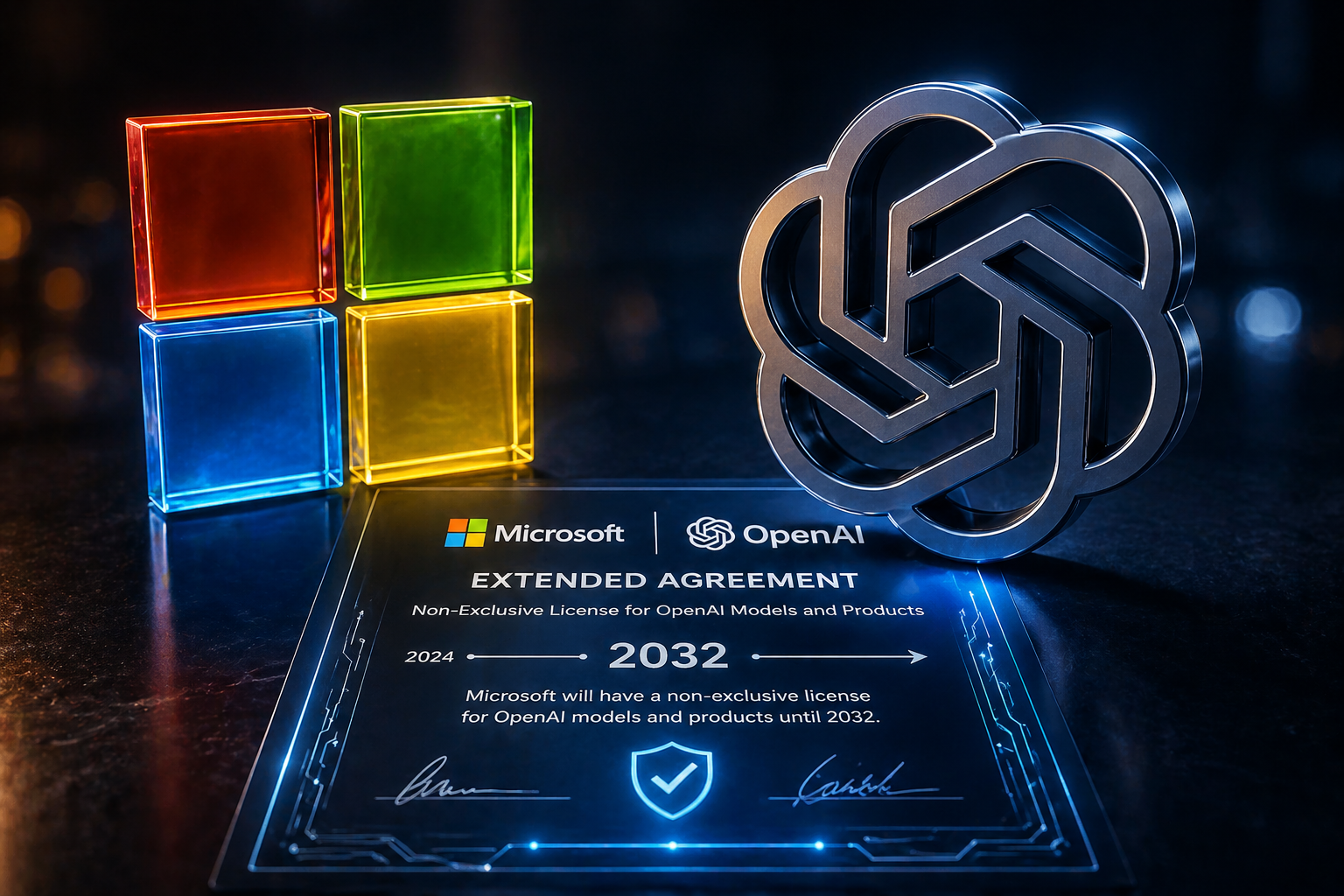
Now, this controversial clause has been completely struck out. Instead of tying the agreement to technical miracles with no set date, it has been converted into a fixed and defined timeline. Microsoft will hold a non-exclusive license for OpenAI models and products until 2032, providing both companies with legal and financial clarity, free from speculation about when superintelligence might emerge.
Rearranging the Financial and Technical House
The amendments did not stop at technical aspects but also included financial affairs. Microsoft will no longer pay a share of revenue to OpenAI, and in return, OpenAI will continue to share its revenue with Microsoft until 2030 at the same previous rate, but with a cap placed on these payments. This change aims to simplify financial matters between the two giants and make cash flows more predictable.
Despite these adjustments, which some might see as a slight distancing, Microsoft emphasized that it will remain a key stakeholder in OpenAI. Collaboration will continue strongly in strategic areas such as developing the next generation of custom AI silicon chips and expanding global data center capabilities. Microsoft realizes its future is tied to OpenAI’s success, and OpenAI realizes that Microsoft’s technical muscle is indispensable.
Ultimately, it seems both parties have matured enough to realize that absolute exclusivity can be a hurdle in a market that changes at lightning speed. This move redraws the competition map and makes us anticipate how OpenAI will leverage its new freedom in choosing cloud providers, and how Microsoft will employ its license extending to 2032 to bolster its position in the world of computing.
There is no doubt that these amendments will spark much debate in the halls of Silicon Valley, as they reflect a shift from a “defensive alliance” to “flexible strategic cooperation.” With the removal of the AGI clause, the focus is now on tangible results and products that reach users’ hands today, rather than long-term future promises.
Source:



Leave a Reply