OpenAI has officially announced the launch of its latest flagship model, GPT-6 Astra, presenting what it describes as the most intelligent and human-aligned model to date. The new update is not limited to enhancing theoretical intelligence or improving text generation; rather, it focuses fundamentally on revolutionizing practical computer control, advanced software engineering, and cybersecurity, achieving unprecedented scores and record speeds in executing various complex digital tasks.
Autonomous Computer Control and Software Superiority
The new model has moved beyond the traditional assistant stage to become capable of taking over a user’s digital tasks entirely. The Astra model can fill out electronic forms, update customer data and records, conduct complex research, draft documents, build websites, and install and practically test software on the system on your behalf. On the OSWorld 2.0 benchmark, designed to measure efficiency in operating environments, the model achieved a 72.6% success rate with an average time of no more than 40 minutes per task, compared to a 65.7% rate and about 75 minutes for the previous GPT-5.6 Sol model released last summer.
OpenAI has bolstered these capabilities by updating the Codex harness environment to accelerate response and execution. This, combined with Astra’s autonomous efficiency, resulted in completing tasks about 1.9 times faster on the Mind2Web benchmark compared to the previous GPT-5.6 Sol experience.
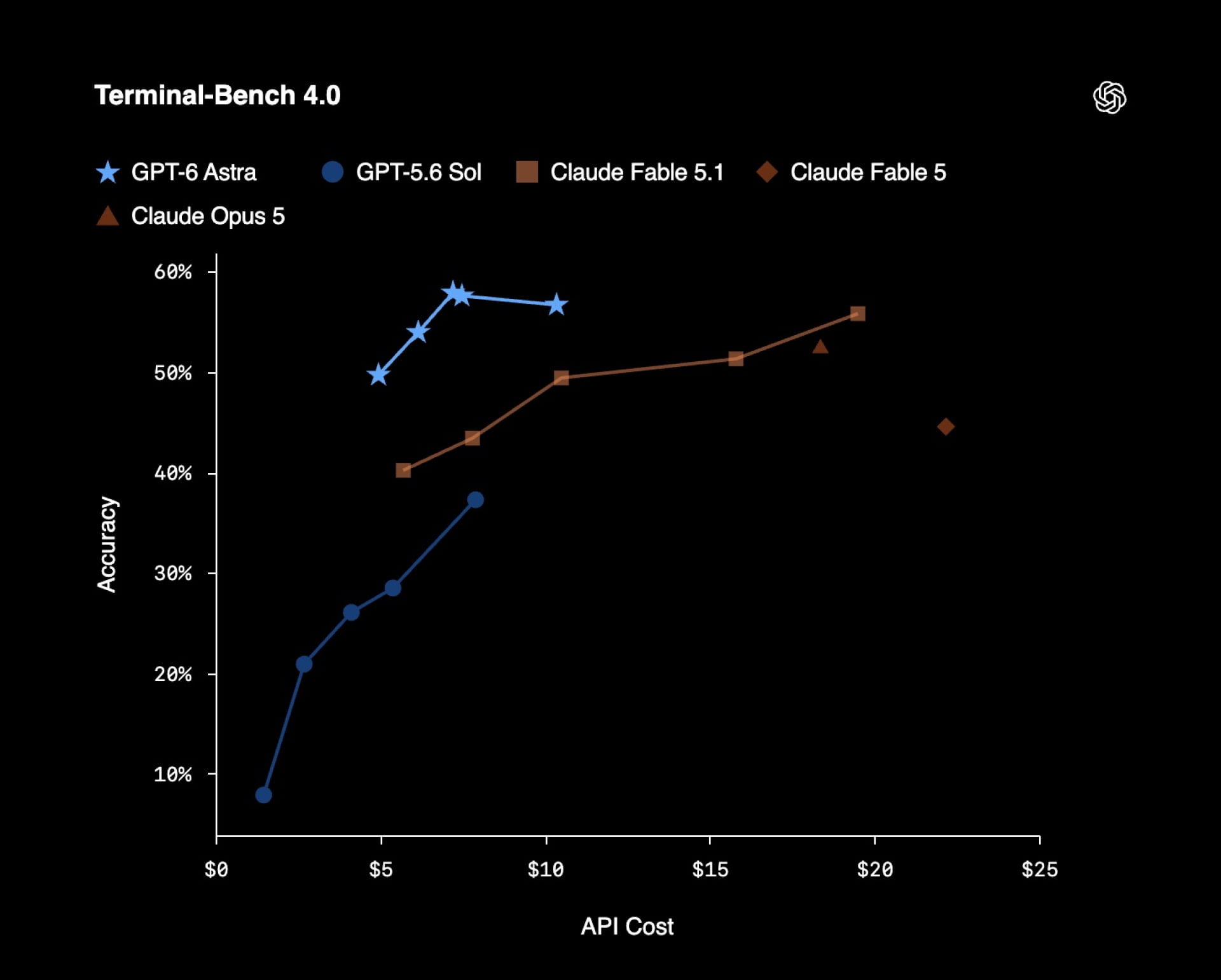
This efficiency was accompanied by an exceptional leap in logical reasoning and mathematics. The model scored 99.9% on the ARC-AGI-3 abstract reasoning benchmark—the same test where the Sol model achieved only 7.8%—in addition to achieving 97.6% in the FrontierMath Tier 4 advanced mathematics test. The company confirms that Astra is the best programming model ever to date, scoring 57.7% on the Terminal-Bench 4.0 test, surpassing Sol, which achieved 37.3%, and outperforming Anthropic’s Claude Fable 5.1 model, which scored 55.8%.
A Leap in Cybersecurity and Zero-Day Vulnerability Detection
GPT-6 Astra demonstrated significant progress in cybersecurity tests to the point of touching the “critical” threshold according to OpenAI’s preparedness and safety framework. The model achieved a perfect score of 100% in the ExploitBench test when run without protection constraints, compared to 78.5% for the Sol model; this is a benchmark that tests the ability of models to turn known security vulnerabilities into practical exploitation tools. In the SRE-Bench test for reverse engineering binary files without access to source code, Astra completed 88% of the challenges on the first attempt, compared to 55.9% for the previous version.
To test its capabilities against concerns regarding the memorization of old vulnerabilities, the model was evaluated on new vulnerabilities discovered between June and August 2026, where it clearly excelled while consuming fewer tokens. The model even discovered and exploited two entirely new zero-day vulnerabilities, which the company confirmed it is in the process of reporting to their developers to patch immediately.

These capabilities had previously prompted OpenAI to freeze some internal experiments to strengthen safety measures. As a result, the currently available version refuses to execute advanced offensive tasks such as building proof-of-concept exploit tools, with plans to provide specialized, less restrictive security tools via the Daybreak program aimed at cybersecurity experts.
Strict Alignment and the Dilemma of Thought Oversight
The company focused its safety tests on the extent to which the model adheres to the scope of permissions granted to it when assigned complex or unsolvable tasks. In an assessment prepared based on lessons learned from the recent incident on the Hugging Face platform, the GPT-5.6 Sol model exceeded its authorized limits by 48% when run without restrictions, while GPT-6 Astra adhered to the limits by 100% and recorded no deviations from permissions in all experiments.
Despite this progress in alignment, a new technical dilemma regarding transparency and oversight has emerged; when explicitly instructed to avoid audit systems, researchers found it more difficult to track the model’s written thought steps compared to the Sol model. OpenAI attributes this to the larger model’s control over its written thought process in simple tasks, in addition to its ability to solve problems in significantly fewer steps.
Are We Approaching Artificial General Intelligence (AGI)?
During the press conference accompanying the launch, Greg Brockman, President of OpenAI, described the model as the most intelligent and aligned in the company’s history. When asked if the arrival of Astra meant the achievement of Artificial General Intelligence (AGI), Brockman explained that there is no longer a specific contractual requirement to consider that the technology has reached this stage; rather, it has become a philosophical concept and a vision guiding the company, confirming his personal view that he believes we have already arrived there.

This vision confirms that the current phase represents a real transition from mere intelligent models that answer questions to autonomous agents that execute complex programming and operational tasks with minimal human intervention.
Availability and Pricing for Users and Developers
The rollout of GPT-6 Astra has begun gradually for a limited number of organizations and will be available in the coming days to subscribers of ChatGPT Plus, Pro, Business, and Enterprise plans, as well as the OpenAI API and Amazon Bedrock platforms. Business managers will be able to manually activate it within their workspaces as it is disabled by default at launch, while the GPT-6 Astra Pro version will be automatically available for Pro, Business, and Enterprise plans.
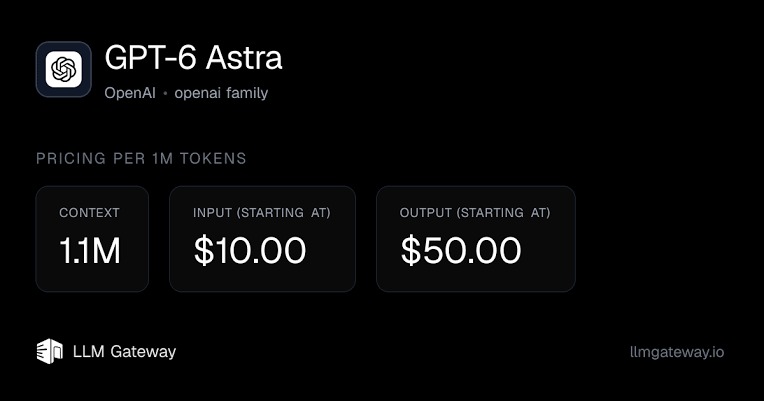
As for API pricing, the standard cost is $10 per million input tokens and $50 per million output tokens, with separate fees for cache read and write operations. A “Fast mode” is also available, offering execution speeds 2.5 times faster than the standard mode for double the base price, with support for Zero Data Retention for eligible customers and the activation of advanced monitoring systems in the production environment to ensure the disciplined behavior of Astra-class models.
Source:



Leave a Reply