The story of Steve Jobs is always told as an inspiring Greek epic: the genius hero who was expelled from his paradise, Apple, only to return triumphant years later to save it from bankruptcy and change the world with devices like the iPhone, the iPad, and others. However, we rarely pause to look behind the scenes of those years he spent in commercial “exile.” Jeffrey Young’s new book, “Steve Jobs in Exile: The Untold Story of NeXT and the Rebuilding of an American Genius,” comes to tell us the other, unpolished side of this journey; a story full of the harsh commercial failures that Jobs faced before becoming the legendary leader we know today.
The bitter exit and the escape to NeXT
Contrary to popular and exciting belief, Steve Jobs was not fired from Apple directly, immediately, and abruptly in 1985. Instead, he was frozen out and “sidelined” into a marginal role without any real authority, until extreme frustration drove him to resign. After his departure, Jobs felt an overwhelming desire to prove himself, so he founded “NeXT Computer,” intelligently targeting a specific market: powerful workstations intended for higher education and scientific research.
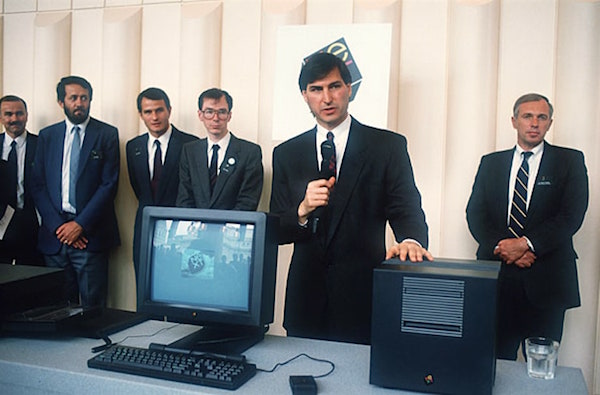
Jobs knew that Apple was not interested in this specialized academic sector at the time, which led him to believe he would avoid costly and distracting lawsuits with his former company, which later proved to be a mere illusion. Jobs set ambitious specifications for the anticipated device, which researchers called the “3M” specs: a megabyte of memory, a display with a million pixels, and a processor capable of handling a million instructions per second, all while not exceeding a price of $10,000 to fit university budgets.
The obsession with details and the self-destruction complex
Here began the real problem and the usual cycle for Steve Jobs. Instead of focusing on delivering a product that met the educational market’s needs at an affordable price, Jobs drowned in his obsession with costly aesthetic and engineering details. He cared about an ultra-luxurious architectural design for the factory that would produce the devices, and he designed the computer case in the shape of a perfect metal cube down to the millimeter, a complex and expensive manufacturing process unprecedented in industrial history.

The result was predictable; the computer produced by NeXT was a dazzling artistic and engineering masterpiece, but it failed completely as a commercial product aimed at students and universities due to its extremely high price and its inability to achieve good sales figures. This pattern of destructive decisions repeated itself over and over; Jobs rejected a huge bailout deal offered to him by the famous investor Ross Perot to sell the devices to US intelligence agencies for satellite image analysis, justifying it by his desire not to deal with government entities!
In another opportunity, NeXT had the potential to sell its advanced operating system to IBM, which would have allowed the system to dominate the personal computer market before Windows took its grip on the world. But Jobs suddenly decided to cancel the deal because he did not feel comfortable working with IBM. Jobs, with his moody personal decisions, was the number one enemy of his own company.
Hard lessons and the great return
Ultimately, the Unix-based operating system and the Mach kernel saved NeXT from total collapse, making it an ideal acquisition target for Apple, which was desperately looking in the late nineties for an alternative operating system to the classic Mac system. Author Jeffrey Young believes that the NeXT years were not just a comfortable graduate school phase where Jobs matured automatically, but a harsh battle where his pride was demolished time and time again.

Jobs finally realized that his intuition was not infallible, and that the “reality distortion field” he is famous for could not change the numbers and commercial facts on the ground. It is worth noting that his greatest success in that era was with Pixar, specifically because he took a completely different path there; he left the artistic and daily management to the creators without direct interference from him.
The Jobs who sold NeXT to Apple and returned to it was not a comfortable hero ready to fight immediately, but a man scarred by wounds, with shattered pride, but who had learned enough from his mistakes to offer Apple a much better version of himself in his historic second term.
Source:

Leave a Reply