One of the long-standing arguments against using Virtual Private Networks (VPN) on smartphones has been their impact on battery life. When you open your phone’s battery settings after a long day of use, you might find the VPN app at the top of the list of apps consuming battery power, perhaps even ahead of your browser or camera. But what if the numbers you see don’t reflect the whole truth? And what if the VPN is being blamed for the consumption of other activities you perform on your phone that it isn’t actually responsible for? In the following lines, we will take you on a quick tour to reveal what really happens to your phone’s battery when a VPN is running, and why the numbers shown on the battery page might be misleading.
Does a VPN consume phone battery?
West Coast Labs, which specializes in testing and evaluating digital apps and services, conducted a recent practical experiment where it measured energy consumption on three Android phones and three Apple devices, as follows:
- Samsung Galaxy S24
- Samsung Galaxy S25 Ultra
- Google Pixel 9
- iPhone 15
- iPhone 16
- A modern iPad
The test was based on simulating a full 24-hour day, including periods of sleep, commuting, working hours, and evening use at home. The scenario was repeated twice: once with the VPN kept on all day, and once without running the VPN.
The experiment result
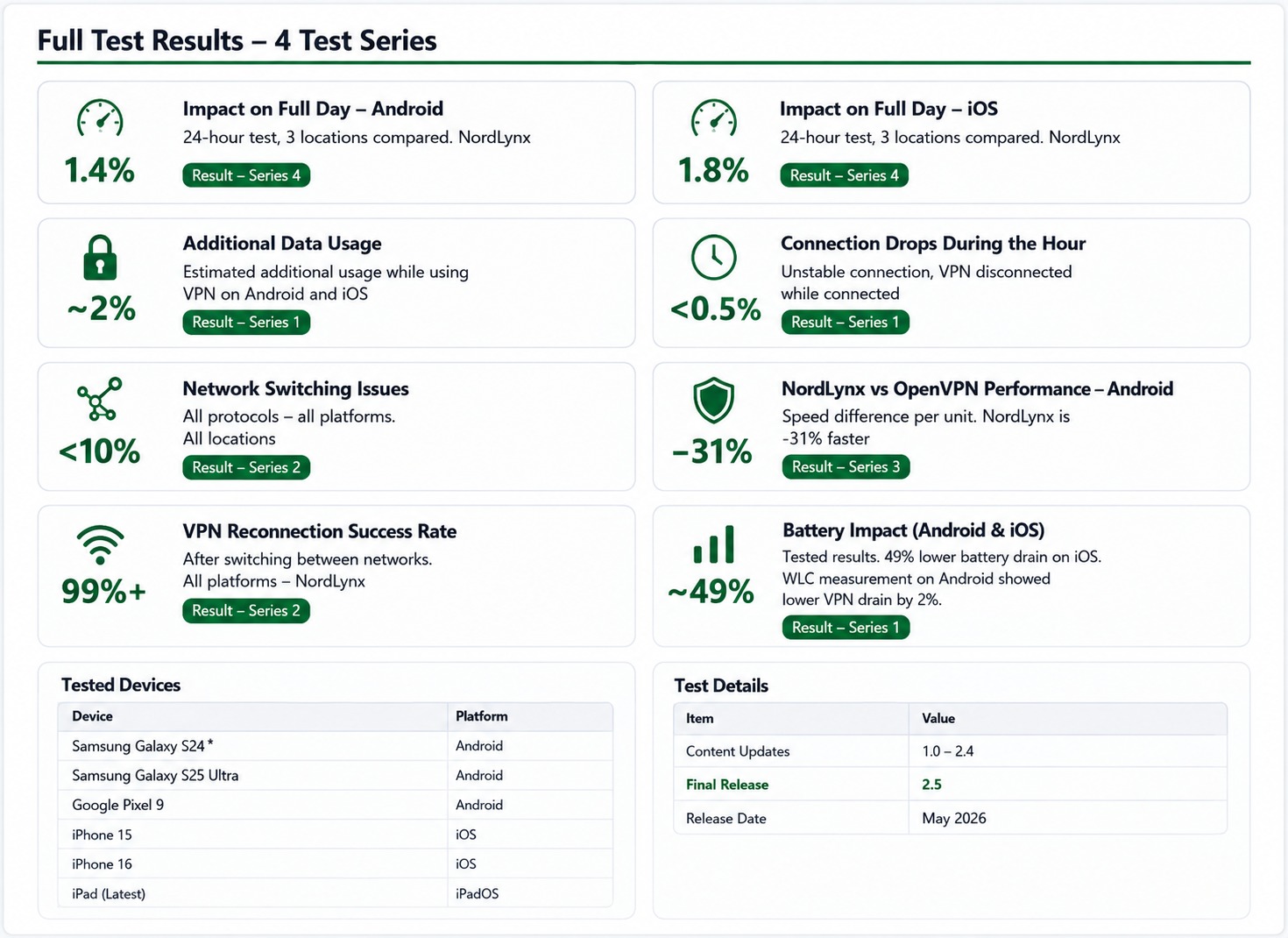
The result was a surprise to users, as the device-level energy consumption measurement showed that the actual overhead of the NordVPN app during a full day of use ranged between only 1.4% and 1.8% on both Android and iPhone systems. Based on these results, the gap between the percentage found in settings and the actual measurements indicates that what you see on your phone’s battery page is not accurate.
Why does the VPN appear to be draining the battery?
The reason lies in how Android and iOS systems calculate app consumption. When a VPN is running, the data packets sent by the phone pass through the app’s encrypted connection. When you use the internet to watch a video, browse a site, or run a streaming service, this data traffic is recorded under the VPN app’s activity.
In other words, if you watch your favorite show on Netflix for an hour while the VPN is connected, the battery screen might attribute a large portion of energy consumption to the VPN app, even though watching the content itself would have required a similar amount of energy even if the VPN were not running.
This was clearly shown in the streaming test, where the device’s battery consumption screen attributed, on average, about 49% of the energy of the usage session to the VPN app. However, when using specialized tools to measure actual electrical current, the real increase associated with the VPN ranged between only 1.6% and 2.1%.
The VPN protocol makes the difference
VPN apps may not consume much of your phone’s battery charge, but that doesn’t mean all VPN apps are equal in energy consumption. The way the protocol works can clearly affect the phone’s efficiency.
VPN protocols refer to the method or technology that the VPN app uses to establish the encrypted connection between your phone and the VPN server. Simply put, when you turn on a VPN, the app needs a specific way to transmit your data over the encrypted connection, and this method is the VPN protocol. Some of the most famous protocols include:
- OpenVPN: An old and popular protocol, but it may consume more resources.
- WireGuard: A newer protocol, designed to be faster, simpler, and more efficient.
- NordLynx: NordVPN’s protocol based on WireGuard technology.
Part of the old reputation of VPN apps for consuming phone resources is linked to the OpenVPN protocol, which appeared in 2001, at a time when encryption efficiency and smartphone battery consumption were not the priorities we know today.
What happens while switching between networks?
There is another scenario that is usually assumed to put more pressure on the phone: switching between networks. When you are on your way to work or during a long trip, the phone may lose connection to the network and reconnect repeatedly, which means the VPN also needs to re-establish the encrypted connection again. That is why this scenario was chosen through a two-hour simulation trip, with networks changing automatically every nine minutes or so.
The increase in energy consumption during each transition was about 5.1% on Android and 6.8% on iOS, figures that remained below the 15% maximum set by the test for this scenario. More importantly, the app succeeded in reconnecting in more than 99 out of every 100 transitions. As for when the phone screen was off and the VPN app was in idle mode, background energy consumption remained below 0.5% of battery capacity per hour.
Finally, the VPN might look like one of the biggest energy consumers in the battery list, but these numbers don’t tell the whole story. When all internet traffic passes through the app, the energy consumed by other activities is recorded under the VPN’s consumption, even though the app itself is not responsible for most of it. Therefore, if you are using a VPN to protect your connection and privacy, there is no need to turn it off because it will not affect your battery charge.
Do you think a VPN drains your phone’s battery? Let us know in the comments!
Source:


Leave a Reply