It seems the AI battle knows no rest, not even for a moment! Just as everyone is looking forward to what the future holds in terms of major updates, Anthropic has surprised us with the launch of its new beast: the Claude Opus 4.8 model. This update doesn’t just bring minor improvements; it redefines how developers and users handle programming and financial analysis tasks, with a feature that might seem strange in today’s AI world: honesty and admitting mistakes instead of hallucinating and making up answers!
A Huge Leap in Programming and Practical Intelligence
Anthropic describes its new Claude Opus 4.8 model as a “more effective collaborative partner,” and the secret lies in significantly developing its capabilities for “Agentic Tasks.” This means it doesn’t just write simple code upon request; it can plan, analyze complex interdisciplinary problems, and even control computer interfaces to complete integrated tasks with unprecedented efficiency.
What is interesting here are the reactions of early testers; they noted that the new model has become smarter and sharper in decision-making, and most importantly, it has become “more honest.” Yes, we are all tired of the visual hallucinations and empty philosophy provided by some models when they don’t know the answer. In Opus 4.8, the model has become more inclined to admit its uncertainty and identify aspects of doubt in its answers instead of making up baseless claims. In terms of numbers, the model is 4 times less likely to pass along code containing errors without flagging them compared to previous versions.
Clear Digital Superiority Over Competitors
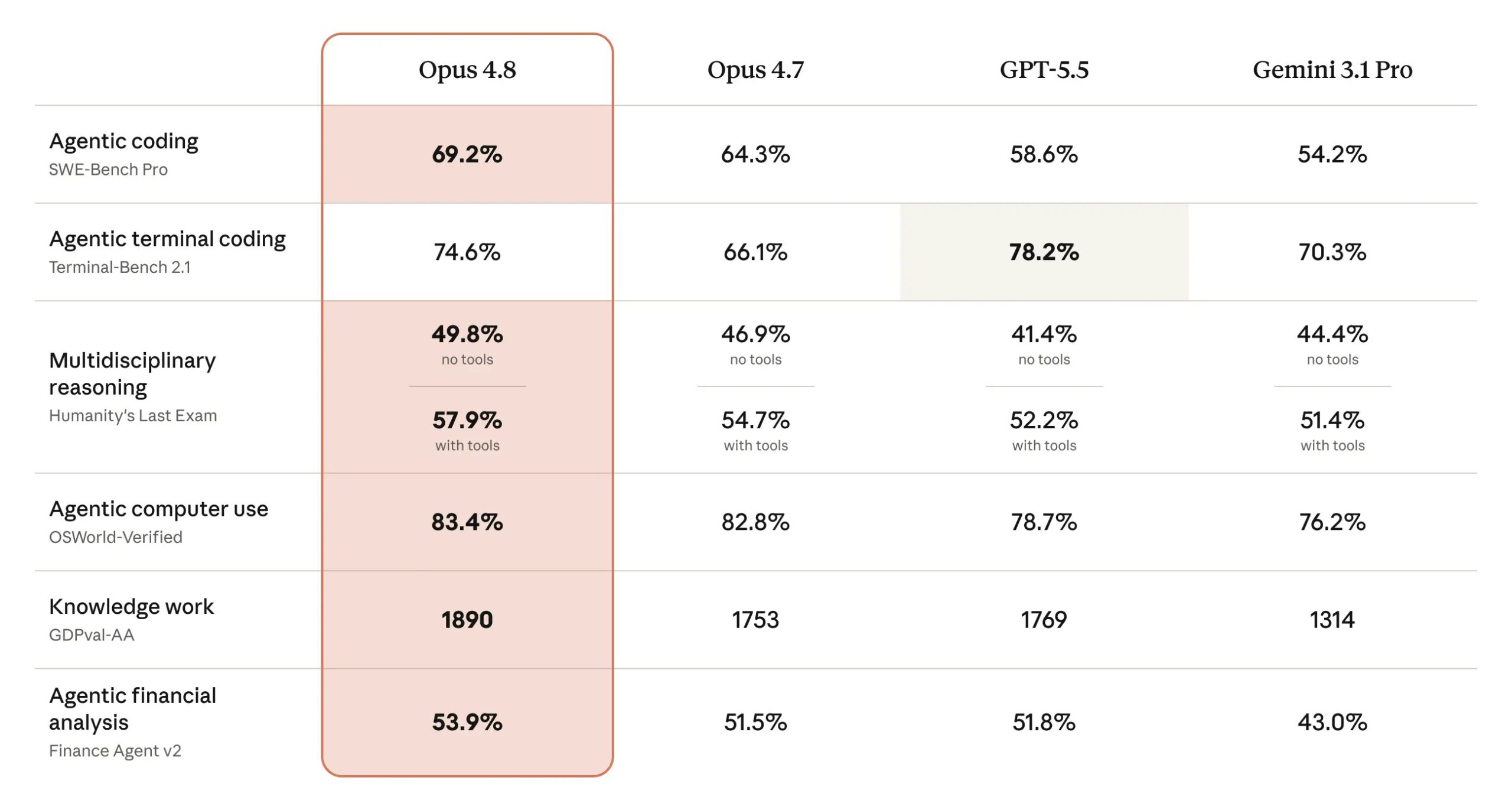
On the front of direct benchmark tests, Claude Opus 4.8 managed to achieve a stunning score of 69.2% on the famous SWE-Bench Pro programming test. This result officially places it in the lead, outperforming fierce competitors like OpenAI’s GPT-5.5 and Google’s Gemini 3.1 Pro. However, GPT-5.5 still holds the edge in terminal-coding tests.
Anthropic didn’t stop at just increasing intelligence; it also addressed two dilemmas that have long plagued developers: speed and cost. Now, the “Fast mode” in Opus 4.8 operates 2.5 times faster than previous versions, and even better, it has become three times cheaper! This means higher efficiency with a much lower bill, which is exactly what businesses and independent developers are looking for. As for regular usage, prices will remain unchanged compared to the previous Opus 4.7 version.
New Features That Give You Full Control
The announcement wasn’t limited to the model itself; Anthropic introduced an arsenal of new features to facilitate the work environment and radically improve productivity:
- Dynamic Workflows: This feature (available as a beta for researchers and subscribers to Business, Team, and Max plans) allows the model to plan massive tasks and run hundreds of sub-agents in parallel within a single session. This means the ability to manage and migrate massive software projects reaching hundreds of thousands of lines of code at once!
- Effort Control: This feature gives Claude.ai and Cowork users the ability to determine the amount of effort and focus the AI exerts in drafting an answer. If you choose less effort, you will get a faster answer and consume your daily quota at a slower rate. By default, Opus 4.8 operates on “High Effort” mode to ensure the perfect balance between quality and user experience.
- Messages API Updates: The company added the ability to update the core instructions given to the model mid-task, giving developers superior flexibility that was not possible before.
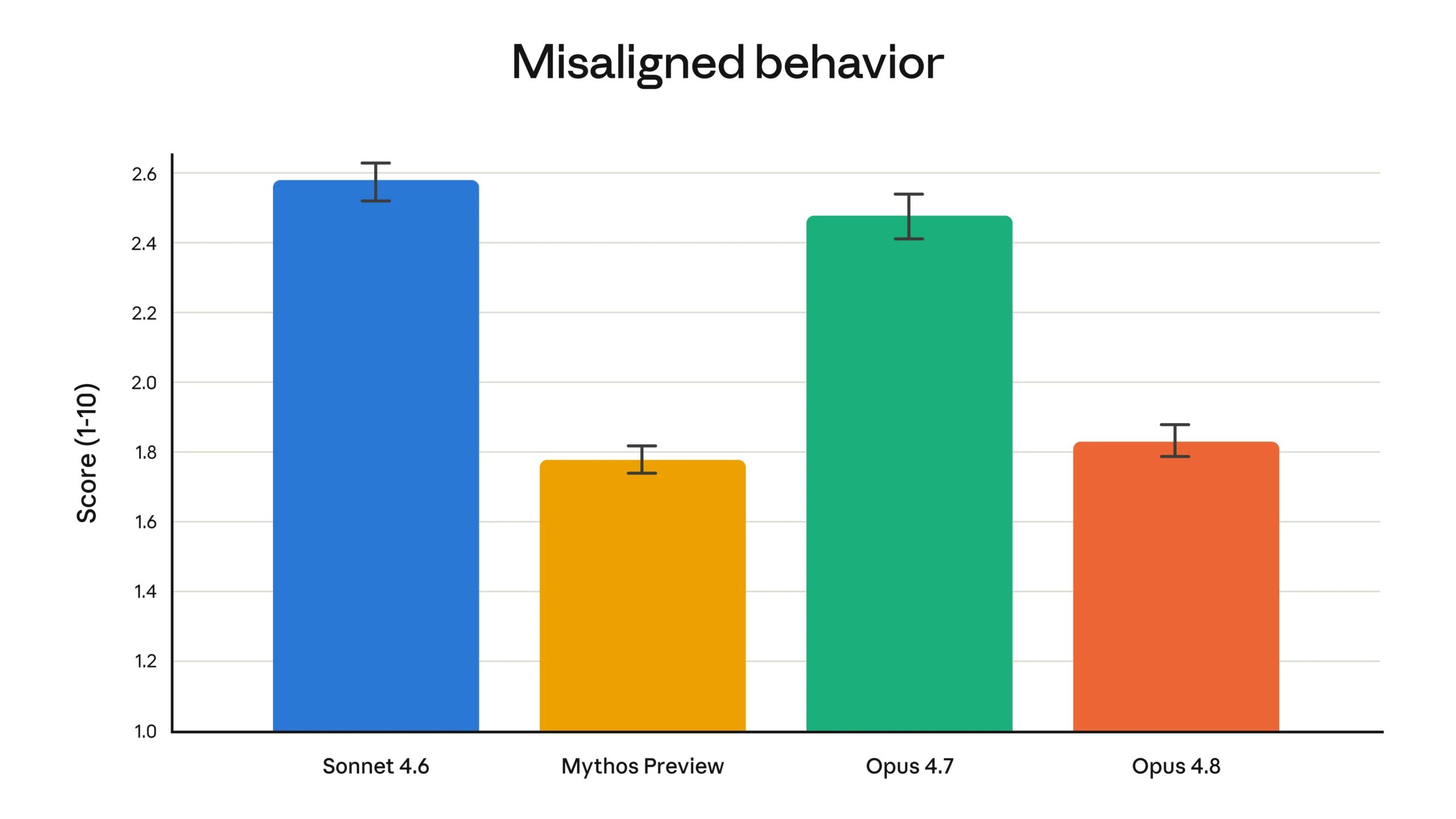
Regarding safety and ethics, evaluations indicate that the model has reached new record levels in “positive social traits,” such as respecting user autonomy and acting in their best interest, with a noticeable decrease in misleading or deceptive behaviors compared to previous versions.
What Does the Near Future Hold for Us?
The immediate worldwide launch of Claude Opus 4.8 today is just the beginning of Anthropic’s ambitious plans. The company is currently working on developing models that offer the same superior capabilities but at a much lower cost to be accessible to everyone, in addition to working on an entirely new class of models that far exceed Opus’s intelligence.
The company also confirmed that it is putting the finishing touches and security safeguards on the “Claude Mythos” model, which is currently being tested with a limited number of organizations (the same model that previously helped discover serious security vulnerabilities in the Mac system), and expects to release it to all customers within the next few weeks. The competition is heating up, and the first and last beneficiaries are we, the users, who see these technical leaps happening before our eyes day after day.
Source:



Leave a Reply