Foldable phones have long tried to convince us that the future lies in folding screens in half, but the practical experience over the years has always hit two hurdles: an internal screen we rarely open to justify the price and weight, and a forced compromise on Apple’s integrated ecosystem that is difficult to leave. Despite trying the most powerful foldable Android phones, none of them succeeded in becoming a permanent daily driver. However, Apple’s unexpected announcement of the “iPhone Duo” has turned the tables, offering an entirely new concept that has even the most skeptical foldable phone critics preparing to pre-order.
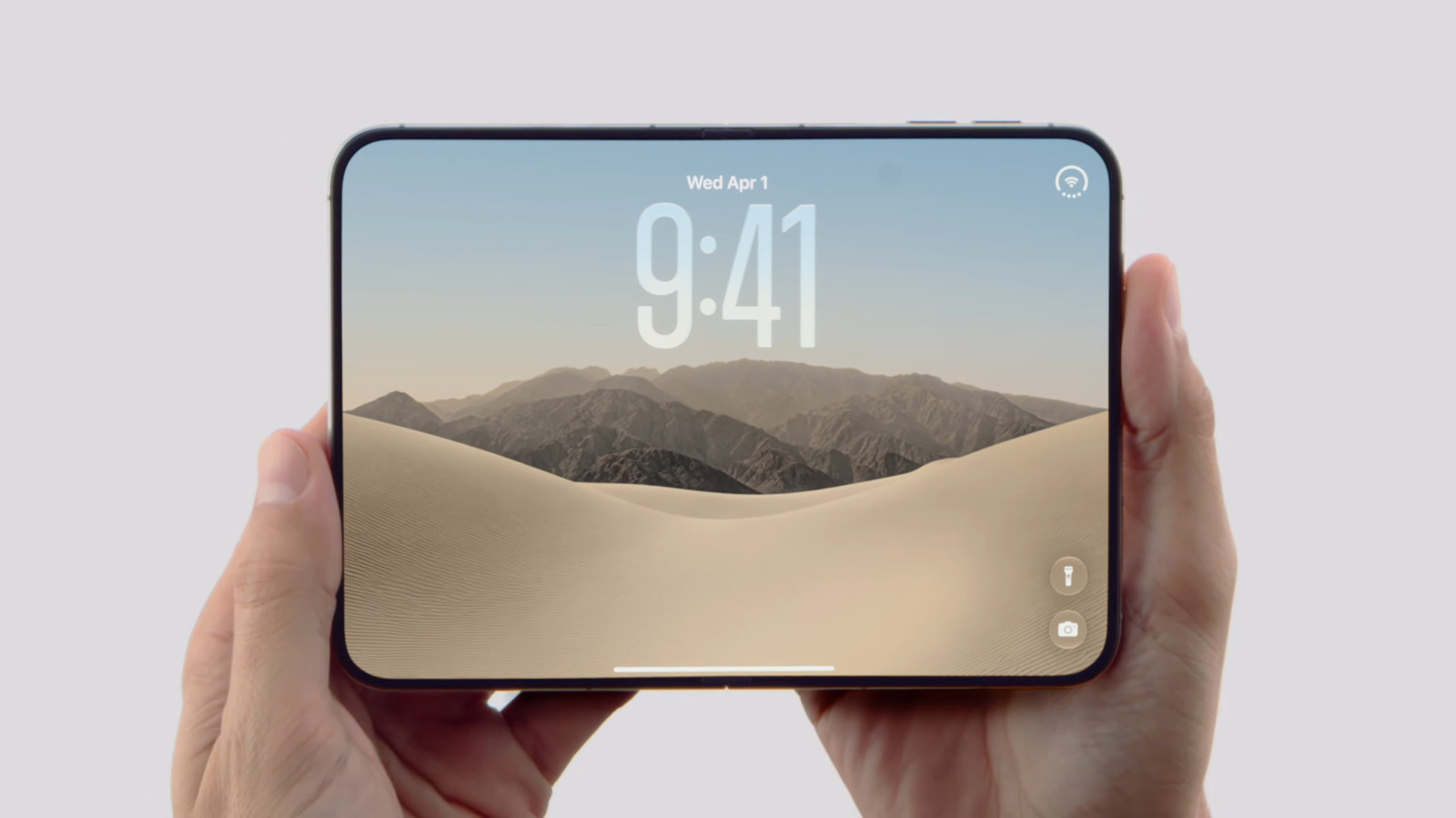
iPhone Duo: Record-breaking thinness and bold compromises
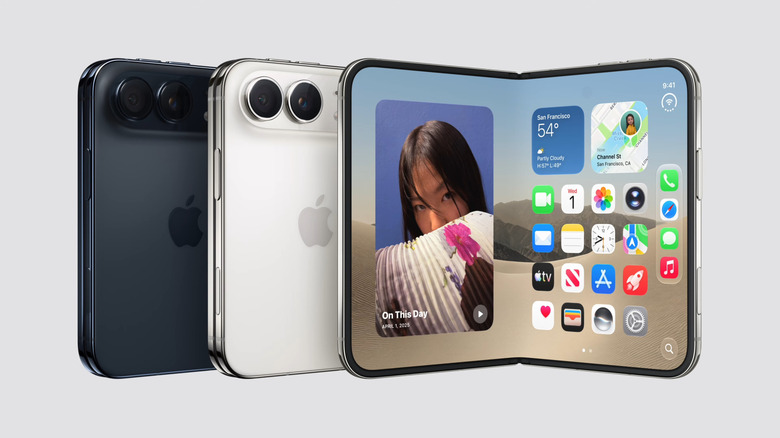
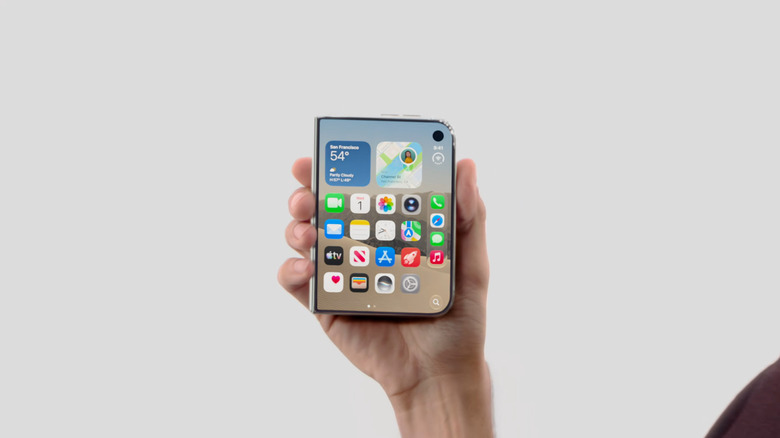
The iPhone Duo features a passport-like design, opening horizontally to reveal a square area very similar to an iPad mini.
Apple adopted a 5.4-inch external screen paired with a massive 7.6-inch flexible internal screen, both sharing the same aspect ratio to ensure content adaptability and smoothness when switching between the two. When closed, the external screen covers about 90% of the iPhone 18 Pro screen area, while the open internal screen is 50% larger than the iPhone 18 Pro Max screen, making it the largest screen ever placed in the history of the iPhone.
The outer frame is made of polished titanium with a reflective sheen similar to the iPhone Air, with a 3D-printed hinge cover.
Apple boasts that the phone, when opened, is the thinnest ever at just 5.2mm, reaching 11.3mm when closed, which makes it thinner than the iPhone Air.
The external screen is equipped with a Ceramic Shield 2 layer with three times the scratch resistance of the previous generation, along with an IP68 rating for water and dust resistance.
Inside, the powerful A20 Pro processor pulses, supported by a vapor chamber for cooling and two batteries distributed on both sides, giving the device a lifespan of up to 31 hours of video playback on the internal screen and 44 hours on the external one.
But this leap did not come without notable sacrifices; Face ID has disappeared entirely in favor of the return of a Touch ID fingerprint sensor embedded in the side button, with the ability to unlock via Apple Watch just as it is on Mac devices.
The rear cameras are limited to two integrated 48-megapixel lenses for the main ultra-wide and ultra-wide lenses, without any telephoto lens, while a selfie camera was placed under the internal screen and another 12-megapixel one on the external screen.
Apple also eliminated both the Action button and the traditional silent switch for the first time, settling for keeping the camera control button, while relying exclusively on eSIM globally.
Has Apple finally solved the screen crease dilemma?
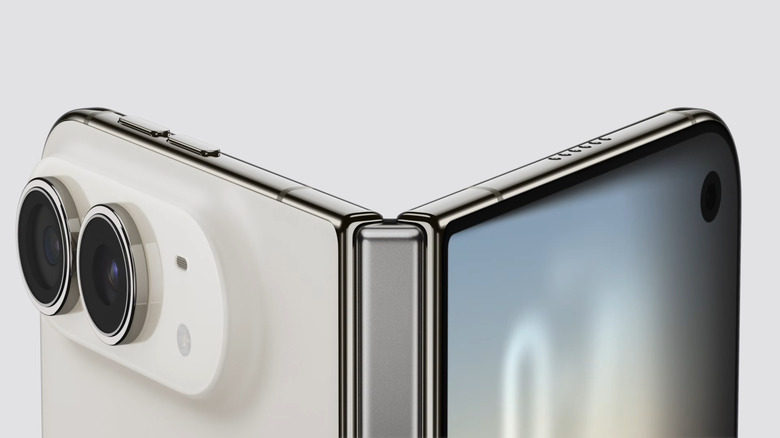
Crease lines are the eternal and common flaw in all foldable phones; even if companies succeed in visually reducing their prominence, the thumb still feels that annoying dip when scrolling continuously. Here, it seems Apple has come closer to the ideal solution than any other competitor thanks to innovative mechanical engineering.
Apple equipped the internal screen with a Nano-texture matte coating that diffuses reflections and significantly reduces glare, which directly contributes to hiding the trace of the fold from the eyes. In the depth, there is ultra-strong glass surrounding the flexible display layer from above and below, supported by special adhesives that allow the layers to slide with extreme smoothness during opening and closing, all based on a titanium bottom plate and an advanced hinge that supports the center of the screen precisely to keep it completely flat.
Initial impressions from experts at the announcement conference confirm the success of this approach; the line appears for moments during the opening process and then almost disappears as soon as the screen is fully flat, and it can only be spotted under sharp and specific lighting angles. Although the final verdict requires months of intensive daily use, the fading of the feeling of the dip under the fingers represents a huge achievement that removes the biggest psychological barriers for users.
The “Passport” design.. The most logical dimensions for the daily user
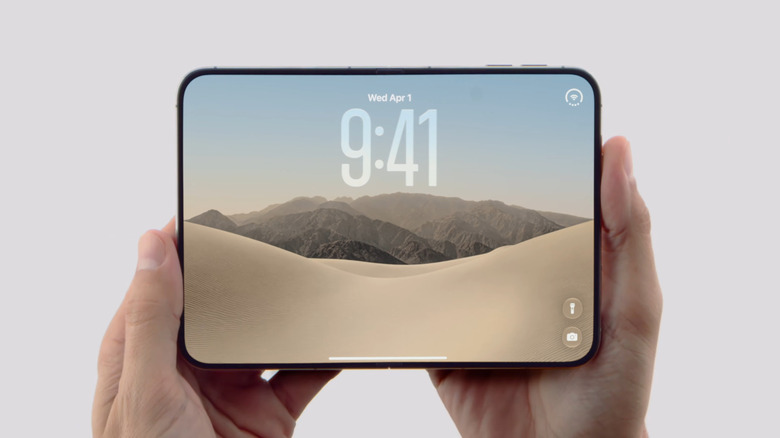
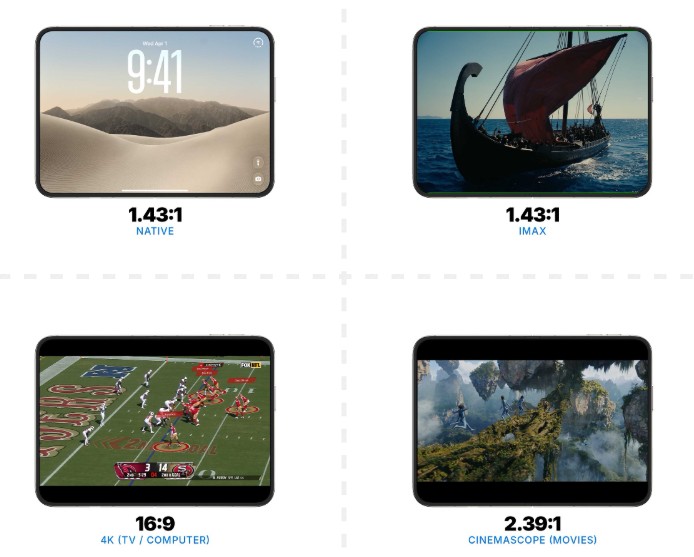
Apple’s choice of passport-like dimensions was the other decisive factor in changing the perspective towards the device. Phones that open into a true square suffer when playing widescreen videos from huge black margins that consume half the display area.
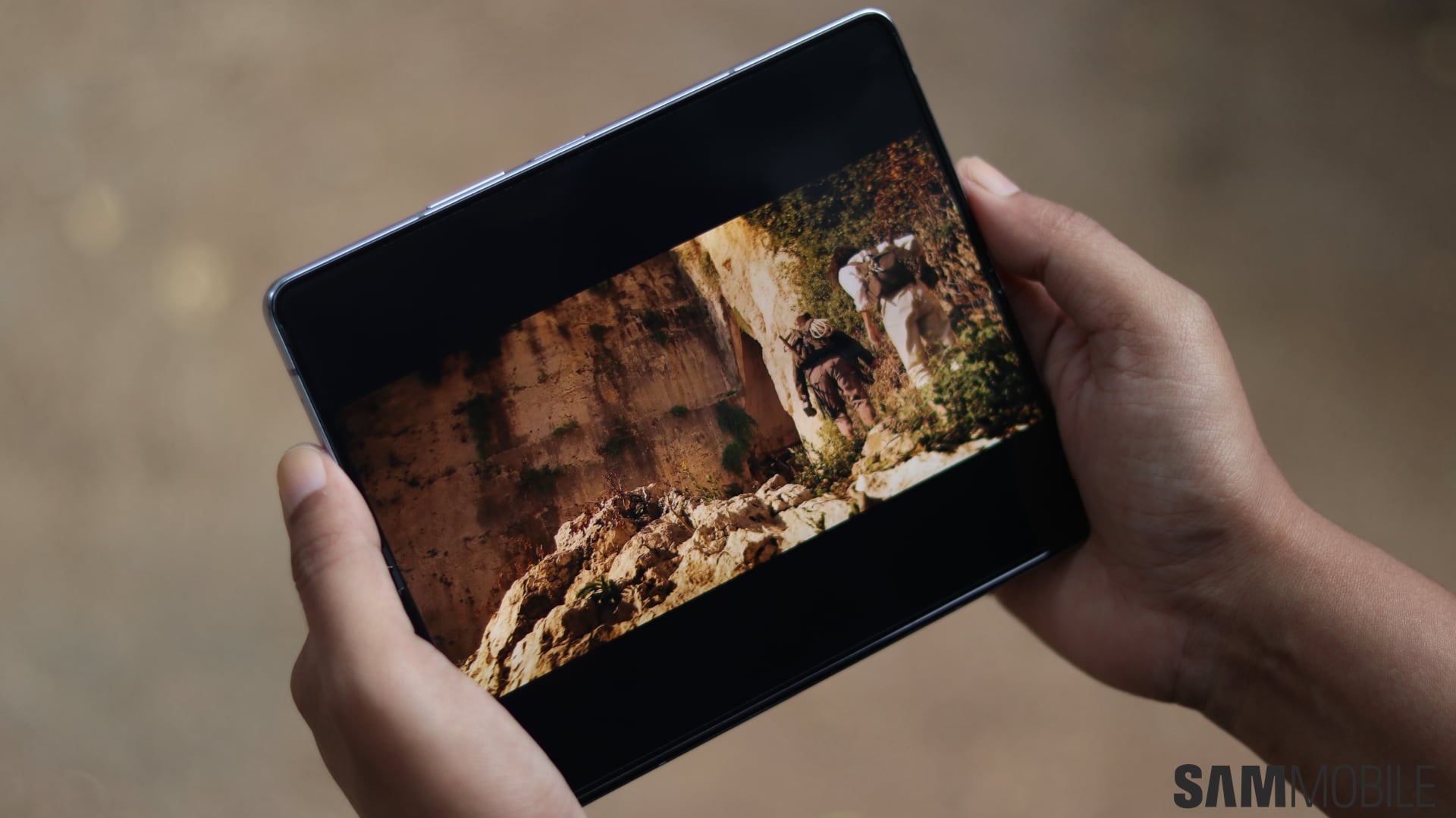
While the wide design of the iPhone Duo gives a very comfortable horizontal space that makes watching content via YouTube or the Apple TV app look wider and clearer than the iPhone Pro Max.
More importantly, it lies in the state of the phone while closed; it is shorter and wider than traditional phones, which makes its overall size in the pocket compact and very comfortable. The basic idea is not just to have a giant screen inside, but to carry a small, practical device in the palm of your hand that can be opened only when needed.
Certainly, there is a downside to this short, wide design, which is that it is less suitable for vertical videos on social media platforms like TikTok and Instagram Reels, where they will appear in a smaller area on the compact external screen. But for those who do not spend most of their time scrolling through short videos, the gains in desktop browsing and reading far outweigh this compromise.
iOS and the ecosystem.. The real secret weapon
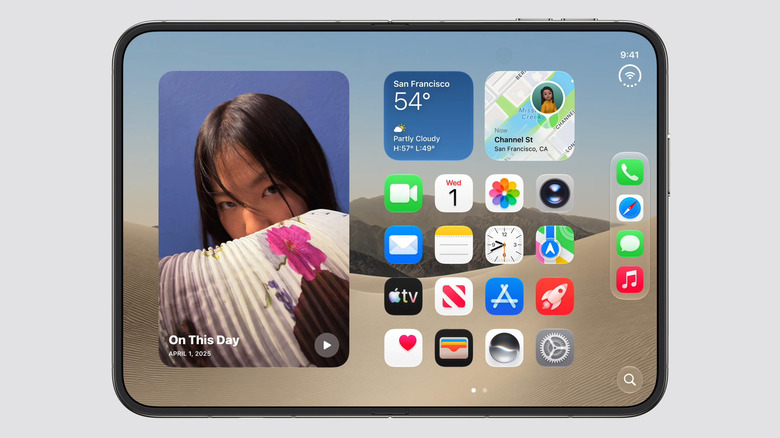
The biggest obstacle to owning any foldable phone from other companies is the forced abandonment of the interconnectedness of Apple products; syncing MacBook, Apple Watch, AirPods, and the daily continuity between them creates an experience that is difficult to replace. With the iPhone Duo, all the benefits of the large screen are available without compromising this integrated ecosystem.
Although the device runs on iOS and not iPadOS, it borrowed the best features of the latter; it supports Split View to run two apps side-by-side for the first time on the iPhone, with opening two windows for the same app, saving favorite app pairs, and using Siri on one side while continuing to work on the other. Apple even moved the Dock bar and navigation buttons to the sides to utilize the vertical space, and redirected the Dynamic Island to flow vertically on the edge in an exceptional touch.
Giant apps like Netflix, Zoom, and Slack immediately announced their support for the new screen dimensions from day one. And if that wasn’t enough, Apple promised to launch Apple Pencil support later this year, making the iPhone Duo the first iPhone you can write and draw on freely.
Cost and compromises: What you should consider before buying
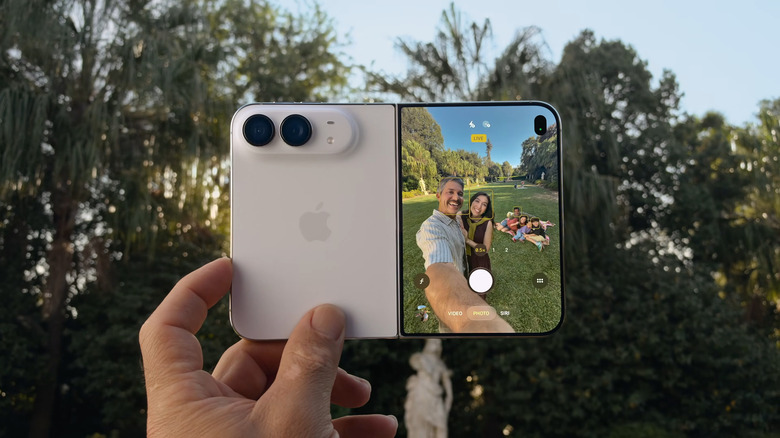
Naturally, no device is perfect, and the iPhone Duo carries its share of challenges. The absence of a telephoto lens is considered the most painful compromise for photography enthusiasts accustomed to long optical zoom in Pro Max models; relying on 2x zoom cropped from the 48-megapixel main sensor, despite its quality, does not compensate for the advanced zoom capabilities in natural and architectural scenes.
Added to this is the sensitive nature of foldable screens; although Apple’s treatment makes the screen 40% more rigid compared to competitors, the flexible surface remains weaker than traditional solid glass, and may be affected by sand grains or excessive pressure from fingernails inside pockets if not given the necessary care.
The price of the iPhone Duo starts at $1,999 for the 256GB capacity, which is a huge amount for a device that represents an entirely new category. Surveys indicate that the majority of users are still hesitant about the idea of foldable screens, but for those who have waited a long time for a design that matures with Apple’s engineering touch and its tight system, the combination of passport dimensions and the power of iOS justifies this pioneering experience.
Source:



Leave a Reply