Heart rate is the speed of the heartbeat, measured by the number of heart contractions per minute. The heart rate varies according to physical needs, such as the need to absorb oxygen and excrete carbon dioxide. The normal heart rate for an adult at rest ranges from 60-100 beats per minute. Tachycardia is known as having the heart beat more than 100 beats per minute at rest. While bradycardia is the heart rate below 60 beats per minute at rest. Numerous studies, as well as the consensus of experts, indicate that a normal adult's resting heart rate ranges between 50-90 beats per minute.
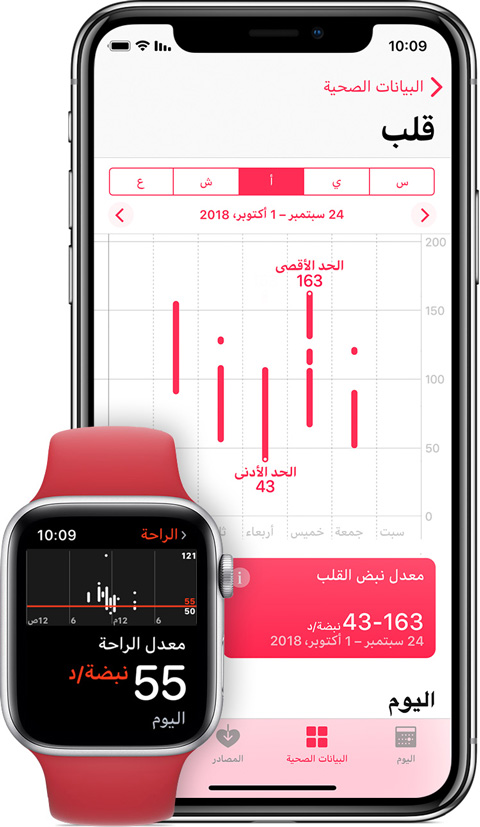
How does Apple Watch measure your heart rate
Apple uses two methods to measure the pulse of the heart, one by using the green light and sensors, and the other by using infrared light to provide energy, and this is the mode that the Apple Watch uses when it measures your heart rate in the background and for notifications of the heart rate. Green LED lights are used to measure your heart rate during exercise and breathing sessions and to calculate average walking and heart rate variation (HRV).
How the optical sensor technology works to measure the heart rate
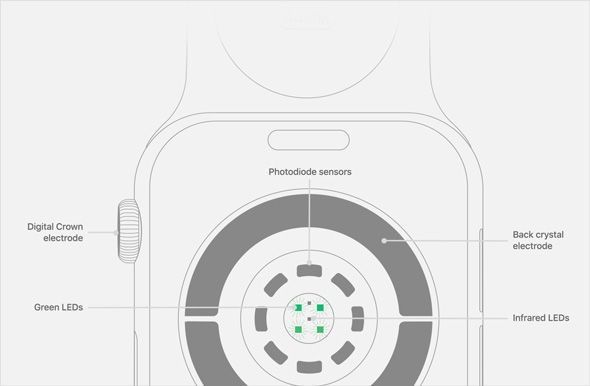
The optical sensor for the heart rate in the Apple Watch uses what is known as optical control planning. This technology is based on a very simple fact: blood is red because it reflects red and absorbs green. The Apple Watch uses green LED lights in addition to light-sensitive photodiodes to detect the amount of blood flowing through the wrist at any given moment. When the heart beats, blood flows in the wrist, and the absorption of the green color is greater. While it decreases between each pulse. And Apple Watch can calculate the number of times the heart beats per minute by flashing the "LED" lights hundreds of times every second, thus calculating your heart rate. The optical heart sensor supports a range of 30 to 210 beats per minute. In addition, the optical heart sensor is designed to compensate for low signal levels by increasing the brightness of the LEDs and the sampling rate.
Apple Watch fourth generation and heart rate
The fourth generation Apple Watch contains electrodes in the Digital Crow button and the back to measure the electrical signals on the heart when used with the application of "heart rate" or the application of ECG. When you place your finger on the watch's ring button, a closed circuit is created between the heart and the arms so that electrical impulses are measured on the chest.
To use the heart rate sensor to measure your heart rate, open the "Heart Rate" app and place your finger on the watch's ring button. You will get a faster and more accurate reading, as the measurement is done at a rate of every second rather than every 5 seconds. You will see an "EKG" in the "Heart Rate" context when looking at the recorded data for the heart rate in the "Sehaty" app.
Many of us know that the ECG or electrical pulse measurement feature only works in watches that were purchased from America or have an American model number, and to learn more, you can read This article, But you can use the electrical heart sensor in the fourth generation of the Apple Watch, it is available without restrictions when used with the heart rate and gives a better and faster measurement.
Source:


42 comment